EMPLOYER
DECATHLON
PLATFORM:
WEB & APP
AREA:
GROWTH, PRODUCT THINKING
YEAR:
2026

The identification loop
Designing a login and account creation vision across 80+ countries
Background
Decathlon is a global sports retailer operating across 80 countries, with a single identity system shared across every market and product. Years of incremental additions had made it feel disjointed. Login and account creation were scattered across touch-points, with checkout on web (75%) and onboarding on app (60%) carrying the heaviest load.
Background
Decathlon is a global sports retailer operating across 80 countries, with a single identity system shared across every market and product. Years of incremental additions had made it feel disjointed. Login and account creation were scattered across touch-points, with checkout on web (75%) and onboarding on app (60%) carrying the heaviest load.
Background
Decathlon is a global sports retailer operating across 80 countries, with a single identity system shared across every market and product. Years of incremental additions had made it feel disjointed. Login and account creation were scattered across touch-points, with checkout on web (75%) and onboarding on app (60%) carrying the heaviest load.
Background
Decathlon is a global sports retailer operating across 80 countries, with a single identity system shared across every market and product. Years of incremental additions had made it feel disjointed. Login and account creation were scattered across touch-points, with checkout on web (75%) and onboarding on app (60%) carrying the heaviest load.

Challenge
We were losing high-intent customers right before the finish line. 24% of web users and 16% of app users who started the login flow dropped off, with the steepest drop (~54%) happening on the very first page. For a flow that sits at the end of a completed shopping journey, that's significant revenue walking out the door.
Challenge
We were losing high-intent customers right before the finish line. 24% of web users and 16% of app users who started the login flow dropped off, with the steepest drop (~54%) happening on the very first page. For a flow that sits at the end of a completed shopping journey, that's significant revenue walking out the door.
Challenge
We were losing high-intent customers right before the finish line. 24% of web users and 16% of app users who started the login flow dropped off, with the steepest drop (~54%) happening on the very first page. For a flow that sits at the end of a completed shopping journey, that's significant revenue walking out the door.
Challenge
We were losing high-intent customers right before the finish line. 24% of web users and 16% of app users who started the login flow dropped off, with the steepest drop (~54%) happening on the very first page. For a flow that sits at the end of a completed shopping journey, that's significant revenue walking out the door.
Role
I led the northstar design for identification across web and app, spanning research synthesis, cross-functional facilitation, and end-to-end concept design.
Role
I led the northstar design for identification across web and app, spanning research synthesis, cross-functional facilitation, and end-to-end concept design.
Role
I led the northstar design for identification across web and app, spanning research synthesis, cross-functional facilitation, and end-to-end concept design.
Role
I led the northstar design for identification across web and app, spanning research synthesis, cross-functional facilitation, and end-to-end concept design.

The identification northstar
The northstar consisted of three levers working in tandem: Simplified login — Make identification feel nearly invisible by reducing cognitive load and authentication complexity. Early authentication — Move identification earlier in the shopping journey so it never becomes a checkout blocker. Anchoring to benefits — Give users a reason to identify by connecting the moment to tangible member value.
The identification northstar
The northstar consisted of three levers working in tandem: Simplified login — Make identification feel nearly invisible by reducing cognitive load and authentication complexity. Early authentication — Move identification earlier in the shopping journey so it never becomes a checkout blocker. Anchoring to benefits — Give users a reason to identify by connecting the moment to tangible member value.
The identification northstar
The northstar consisted of three levers working in tandem: Simplified login — Make identification feel nearly invisible by reducing cognitive load and authentication complexity. Early authentication — Move identification earlier in the shopping journey so it never becomes a checkout blocker. Anchoring to benefits — Give users a reason to identify by connecting the moment to tangible member value.
The identification northstar
The northstar consisted of three levers working in tandem: Simplified login — Make identification feel nearly invisible by reducing cognitive load and authentication complexity. Early authentication — Move identification earlier in the shopping journey so it never becomes a checkout blocker. Anchoring to benefits — Give users a reason to identify by connecting the moment to tangible member value.
Simplifying login with clarity and ease
Forgotten passwords were the top reason customers abandoned the login flow (surfaced through CSAT), so I introduced passkey support: users could set one up once and return instantly on their next visit, no password required. For users who needed other paths, I designed an overlay with alternative sign-in options. That kept the default interface clean while still accommodating country-specific needs like WhatsApp authentication without cluttering the main flow.
Simplifying login with clarity and ease
Forgotten passwords were the top reason customers abandoned the login flow (surfaced through CSAT), so I introduced passkey support: users could set one up once and return instantly on their next visit, no password required. For users who needed other paths, I designed an overlay with alternative sign-in options. That kept the default interface clean while still accommodating country-specific needs like WhatsApp authentication without cluttering the main flow.
Simplifying login with clarity and ease
Forgotten passwords were the top reason customers abandoned the login flow (surfaced through CSAT), so I introduced passkey support: users could set one up once and return instantly on their next visit, no password required. For users who needed other paths, I designed an overlay with alternative sign-in options. That kept the default interface clean while still accommodating country-specific needs like WhatsApp authentication without cluttering the main flow.
Simplifying login with clarity and ease
Forgotten passwords were the top reason customers abandoned the login flow (surfaced through CSAT), so I introduced passkey support: users could set one up once and return instantly on their next visit, no password required. For users who needed other paths, I designed an overlay with alternative sign-in options. That kept the default interface clean while still accommodating country-specific needs like WhatsApp authentication without cluttering the main flow.
A single entry point
The core principle was making identification feel like a natural part of the experience, not a gate in front of it. Fewer decisions on screen, less visual noise, and a single entry point that handled both login and account creation, doing the heavy lifting for the user rather than presenting them with a fork in the road.
The B2B entry point was separated out entirely. With 95% of users being B2C, there was no reason to route the majority through a step designed for the minority. Business login became its own discrete path, surfaced only where relevant.
A single entry point
The core principle was making identification feel like a natural part of the experience, not a gate in front of it. Fewer decisions on screen, less visual noise, and a single entry point that handled both login and account creation, doing the heavy lifting for the user rather than presenting them with a fork in the road.
The B2B entry point was separated out entirely. With 95% of users being B2C, there was no reason to route the majority through a step designed for the minority. Business login became its own discrete path, surfaced only where relevant.
A single entry point
The core principle was making identification feel like a natural part of the experience, not a gate in front of it. Fewer decisions on screen, less visual noise, and a single entry point that handled both login and account creation, doing the heavy lifting for the user rather than presenting them with a fork in the road.
The B2B entry point was separated out entirely. With 95% of users being B2C, there was no reason to route the majority through a step designed for the minority. Business login became its own discrete path, surfaced only where relevant.
A single entry point
The core principle was making identification feel like a natural part of the experience, not a gate in front of it. Fewer decisions on screen, less visual noise, and a single entry point that handled both login and account creation, doing the heavy lifting for the user rather than presenting them with a fork in the road.
The B2B entry point was separated out entirely. With 95% of users being B2C, there was no reason to route the majority through a step designed for the minority. Business login became its own discrete path, surfaced only where relevant.
Early authentication
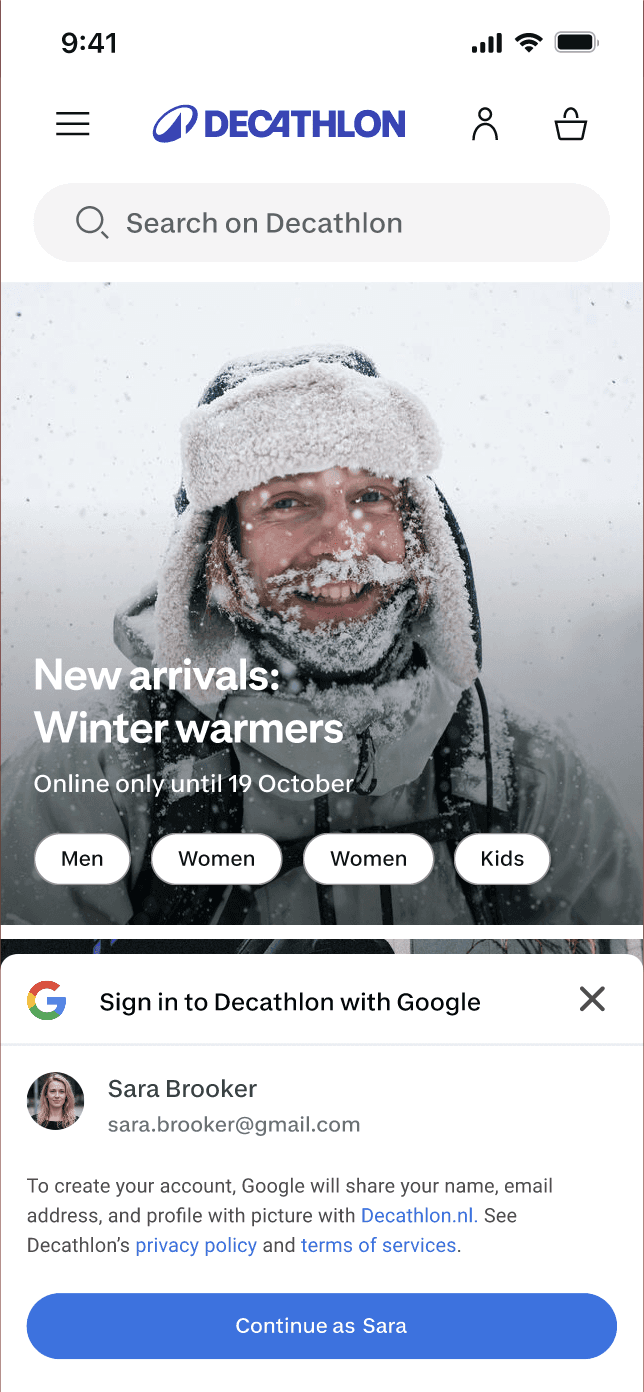
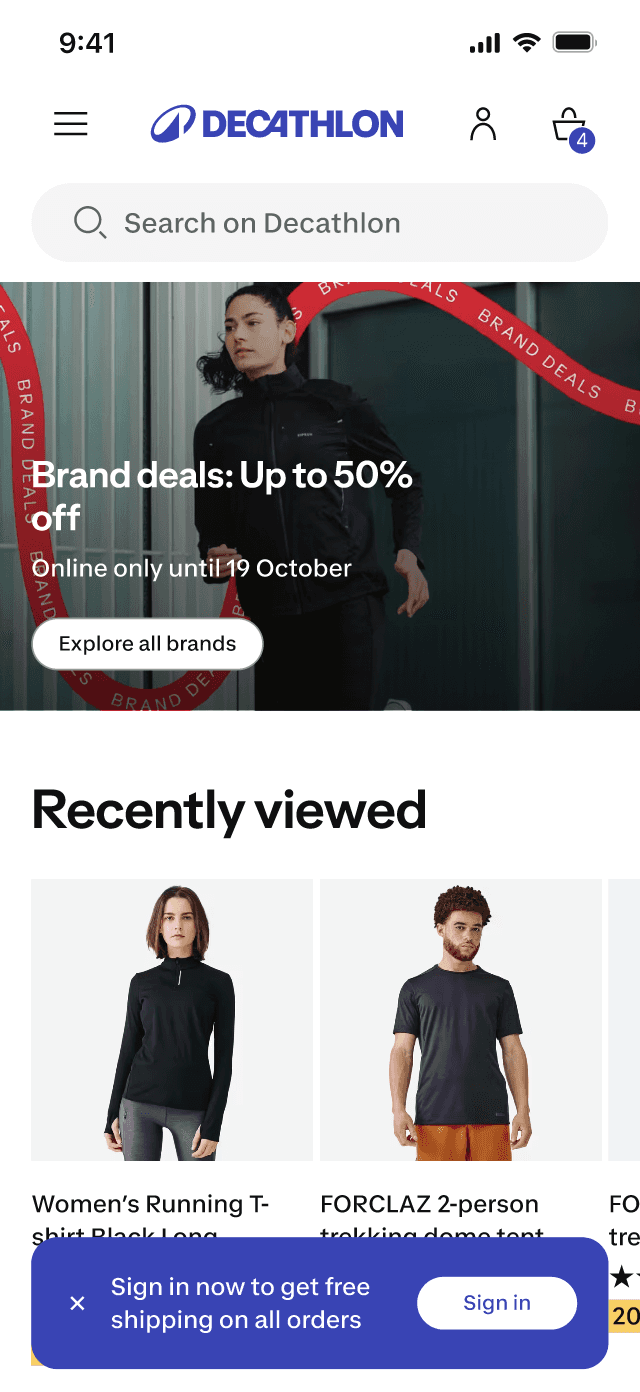
The checkout drop-off existed partly because identification was happening too late. Users had already committed mentally to their purchase before being asked to log in, making the interruption feel jarring. The northstar moved identification earlier in the journey, when the ask felt more natural. Google One Tap on the homepage was a direct response to data showing 26% of sign-ins came through Google. Surfacing it passively while users were still browsing, before they'd even added anything to their cart meant a significant share of users could arrive at checkout already identified, removing the bottleneck entirely.
Early authentication
The checkout drop-off existed partly because identification was happening too late. Users had already committed mentally to their purchase before being asked to log in, making the interruption feel jarring. The northstar moved identification earlier in the journey, when the ask felt more natural. Google One Tap on the homepage was a direct response to data showing 26% of sign-ins came through Google. Surfacing it passively while users were still browsing, before they'd even added anything to their cart meant a significant share of users could arrive at checkout already identified, removing the bottleneck entirely.
Early authentication
The checkout drop-off existed partly because identification was happening too late users had already committed mentally to their purchase before being asked to log in, making the interruption feel jarring. The northstar moved identification earlier in the journey, when the ask felt more natural. Google One Tap on the homepage was a direct response to data showing 26% of sign-ins came through Google. Surfacing it passively while users were still browsing, before they'd even added anything to their cart meant a significant share of users could arrive at checkout already identified, removing the bottleneck entirely.
Early authentication
The checkout drop-off existed partly because identification was happening too late. Users had already committed mentally to their purchase before being asked to log in, making the interruption feel jarring. The northstar moved identification earlier in the journey, when the ask felt more natural. Google One Tap on the homepage was a direct response to data showing 26% of sign-ins came through Google. Surfacing it passively while users were still browsing, before they'd even added anything to their cart meant a significant share of users could arrive at checkout already identified, removing the bottleneck entirely.
Anchoring to benefits
Motivation was as much a problem as friction. Users opting for guest checkout weren't necessarily opposed to creating an account. They just didn't have a reason to in the moment. We addressed this by surfacing what they were leaving on the table: loyalty points lost by not identifying, and free delivery eligibility shown at the payment details step, when cost is front of mind.
Anchoring to benefits
Motivation was as much a problem as friction. Users opting for guest checkout weren't necessarily opposed to creating an account. They just didn't have a reason to in the moment. We addressed this by surfacing what they were leaving on the table: loyalty points lost by not identifying, and free delivery eligibility shown at the payment details step, when cost is front of mind.
Anchoring to benefits
Motivation was as much a problem as friction. Users opting for guest checkout weren't necessarily opposed to creating an account. They just didn't have a reason to in the moment. We addressed this by surfacing what they were leaving on the table: loyalty points lost by not identifying, and free delivery eligibility shown at the payment details step, when cost is front of mind.
Anchoring to benefits
Motivation was as much a problem as friction. Users opting for guest checkout weren't necessarily opposed to creating an account. They just didn't have a reason to in the moment. We addressed this by surfacing what they were leaving on the table: loyalty points lost by not identifying, and free delivery eligibility shown at the payment details step, when cost is front of mind.
Benefits at onboarding
On app, the approach was different. Getting users to their browsing experience quickly was the priority so identification was lightweight upfront, with a prompt to set up a passkey introduced after they'd already engaged with the product.
Benefits at onboarding
On app, the approach was different. Getting users to their browsing experience quickly was the priority so identification was lightweight upfront, with a prompt to set up a passkey introduced after they'd already engaged with the product.
Benefits at onboarding
On app, the approach was different. Getting users to their browsing experience quickly was the priority so identification was lightweight upfront, with a prompt to set up a passkey introduced after they'd already engaged with the product.
Benefits at onboarding
On app, the approach was different. Getting users to their browsing experience quickly was the priority so identification was lightweight upfront, with a prompt to set up a passkey introduced after they'd already engaged with the product.
Impact
Impact
Impact
Impact
+0.5%
Identified conversion rate
+1.45%
Login conversion rate
+1.48%
Social logins
+0.5%
Identified conversion rate
+1.45%
Login conversion rate
+1.48%
Social logins
+0.5%
Identified conversion rate
+1.45%
Login conversion rate
+1.48%
Social logins
+0.5%
Identified conversion rate
+1.45%
Login conversion rate
+1.48%
Social logins
+0.97%
Account creation
1.8M
Revenue
+0.97%
Account creation
1.8M
Revenue
+0.97%
Account creation
1.8M
Revenue
+0.97%
Account creation
1.8M
Revenue
Key decisions
Key decisions
Key decisions
Key decisions
Remove visual noise and surface social login earlier
Hypothesis: Users were spending cognitive energy on an authentication page that was doing too much. By stripping back imagery and making social login options more prominent, we expected to reduce hesitation and increase the proportion of users completing login particularly those who couldn't recall their password.
This tested positively: social login conversion increased by +1.48%
Remove visual noise and surface social login earlier
Hypothesis: Users were spending cognitive energy on an authentication page that was doing too much. By stripping back imagery and making social login options more prominent, we expected to reduce hesitation and increase the proportion of users completing login particularly those who couldn't recall their password.
This tested positively: social login conversion increased by +1.48%
Remove visual noise and surface social login earlier
Hypothesis: Users were spending cognitive energy on an authentication page that was doing too much. By stripping back imagery and making social login options more prominent, we expected to reduce hesitation and increase the proportion of users completing login particularly those who couldn't recall their password.
This tested positively: social login conversion increased by +1.48%
Remove visual noise and surface social login earlier
Hypothesis: Users were spending cognitive energy on an authentication page that was doing too much. By stripping back imagery and making social login options more prominent, we expected to reduce hesitation and increase the proportion of users completing login particularly those who couldn't recall their password.
This tested positively: social login conversion increased by +1.48%
Start account creation with OTP and make password optional
Hypothesis: Password creation is the single highest-friction moment in account creation.It requires inventing, typing, and remembering something new mid-checkout. By reversing the flow to start with OTP verification and defer password creation, we expected to lower the barrier for new accounts while still giving users a path to set one later.
This drove +0.97% in account creations and contributed to +1.45% login conversion rate overall.
Start account creation with OTP and make password optional
Hypothesis: Password creation is the single highest-friction moment in account creation.It requires inventing, typing, and remembering something new mid-checkout. By reversing the flow to start with OTP verification and defer password creation, we expected to lower the barrier for new accounts while still giving users a path to set one later.
This drove +0.97% in account creations and contributed to +1.45% login conversion rate overall.
Start account creation with OTP and make password optional
Hypothesis: Password creation is the single highest-friction moment in account creation.It requires inventing, typing, and remembering something new mid-checkout. By reversing the flow to start with OTP verification and defer password creation, we expected to lower the barrier for new accounts while still giving users a path to set one later.
This drove +0.97% in account creations and contributed to +1.45% login conversion rate overall.
Start account creation with OTP and make password optional
Hypothesis: Password creation is the single highest-friction moment in account creation.It requires inventing, typing, and remembering something new mid-checkout. By reversing the flow to start with OTP verification and defer password creation, we expected to lower the barrier for new accounts while still giving users a path to set one later.
This drove +0.97% in account creations and contributed to +1.45% login conversion rate overall.
Compress 80 country flows into 5 scalable configurations
Using internal research and competitor analysis, I defined a north star experience across Web, iOS, and Android. The core idea was to make the start easier for new sellers, ask for information at the right moments, and stay compliant.
A UX researcher and I tested the concept with recently onboarded sellers to compare perceived effort against the existing flow. This gave us an early signal before committing to phased rollout.
Compress 80 country flows into 5 scalable configurations
Using internal research and competitor analysis, I defined a north star experience across Web, iOS, and Android. The core idea was to make the start easier for new sellers, ask for information at the right moments, and stay compliant.
A UX researcher and I tested the concept with recently onboarded sellers to compare perceived effort against the existing flow. This gave us an early signal before committing to phased rollout.
Compress 80 country flows into 5 scalable configurations
Using internal research and competitor analysis, I defined a north star experience across Web, iOS, and Android. The core idea was to make the start easier for new sellers, ask for information at the right moments, and stay compliant.
Compress 80 country flows into 5 scalable configurations
Using internal research and competitor analysis, I defined a north star experience across Web, iOS, and Android. The core idea was to make the start easier for new sellers, ask for information at the right moments, and stay compliant.
A UX researcher and I tested the concept with recently onboarded sellers to compare perceived effort against the existing flow. This gave us an early signal before committing to phased rollout.


Country configurations and journey mapping
Country configurations and journey mapping
Country configurations and journey mapping
Country configurations and journey mapping
Reflection
Reflection
Reflection
Reflection
What went well
Running a cross-domain sprint with teams from checkout, CRM, membership, and store early in the process meant the northstar had buy-in before it was designed. The facilitation investment upfront saved alignment cycles later.
What went well
Running a cross-domain sprint with teams from checkout, CRM, membership, and store early in the process meant the northstar had buy-in before it was designed. The facilitation investment upfront saved alignment cycles later.
What went well
Running a cross-domain sprint with teams from checkout, CRM, membership, and store early in the process meant the northstar had buy-in before it was designed. The facilitation investment upfront saved alignment cycles later.
What went well
Running a cross-domain sprint with teams from checkout, CRM, membership, and store early in the process meant the northstar had buy-in before it was designed. The facilitation investment upfront saved alignment cycles later.
What I'd do differently
The mobile prototype, built to be typed into on a real keypad was one of the most useful research tools we had. I'd introduce that kind of high-fidelity interaction prototype earlier, before the northstar was fully locked, to surface friction points while there's still room to change the flows.
What I'd do differently
The mobile prototype, built to be typed into on a real keypad was one of the most useful research tools we had. I'd introduce that kind of high-fidelity interaction prototype earlier, before the northstar was fully locked, to surface friction points while there's still room to change the flows.
What I'd do differently
The mobile prototype, built to be typed into on a real keypad was one of the most useful research tools we had. I'd introduce that kind of high-fidelity interaction prototype earlier, before the northstar was fully locked, to surface friction points while there's still room to change the flows.
What I'd do differently
The mobile prototype, built to be typed into on a real keypad was one of the most useful research tools we had. I'd introduce that kind of high-fidelity interaction prototype earlier, before the northstar was fully locked, to surface friction points while there's still room to change the flows.
more cases.
more cases.

