EMPLOYER
CATAWIKI
PLATFORM:
WEB & MOBILE
AREA:
DESIGN, STRATEGY, RESEARCH
YEAR:
2024

Starting with an object
Adapting the seller's listing experience to support marketplace growth
Background
Catawiki is a curated online auction marketplace for unique objects, from classic cars to rare coins. In 2022, the company set a bold ambition: quadruple the seller base over five years.
Scaling sellers meant scaling inventory, but scaling inventory required better data. At the time, object data was largely unstructured and category-driven. To improve buyer discoverability and future automation, we needed to shift to a structured, object-centered data model.
Background
Catawiki is a curated online auction marketplace for unique objects, from classic cars to rare coins. In 2022, the company set a bold ambition: quadruple the seller base over five years.
Scaling sellers meant scaling inventory, but scaling inventory required better data. At the time, object data was largely unstructured and category-driven. To improve buyer discoverability and future automation, we needed to shift to a structured, object-centered data model.
Background
Catawiki is a curated online auction marketplace for unique objects, from classic cars to rare coins. In 2022, the company set a bold ambition: quadruple the seller base over five years.
Scaling sellers meant scaling inventory, but scaling inventory required better data. At the time, object data was largely unstructured and category-driven. To improve buyer discoverability and future automation, we needed to shift to a structured, object-centered data model.
Background
Catawiki is a curated online auction marketplace for unique objects, from classic cars to rare coins. In 2022, the company set a bold ambition: quadruple the seller base over five years.
Scaling sellers meant scaling inventory, but scaling inventory required better data. At the time, object data was largely unstructured and category-driven. To improve buyer discoverability and future automation, we needed to shift to a structured, object-centered data model.
The change wasn’t isolated to one surface. It affected three interconnected systems at Catawiki:
1
Experts - who curate objects and move them between auctions
2
Commercial teams - who structure marketplace strategy
3
Sellers - who feed the entire system with inventory
The change wasn’t isolated to one surface. It affected three interconnected systems at Catawiki:
1
Experts - who curate objects and move them between auctions
2
Commercial teams - who structure marketplace strategy
3
Sellers - who feed the entire system with inventory
The change wasn’t isolated to one surface. It affected three interconnected systems at Catawiki:
1
Experts - who curate objects and move them between auctions
2
Commercial teams - who structure marketplace strategy
3
Sellers - who feed the entire system with inventory
The change wasn’t isolated to one surface. It affected three interconnected systems at Catawiki:
1
Experts - who curate objects and move them between auctions
2
Commercial teams - who structure marketplace strategy
3
Sellers - who feed the entire system with inventory

The challenge
Adapt the seller listing flow to a new structured data system while, maintaining key business metrics, preserving pro seller efficiency and minimizing confusion during the transition.
More than a visual re-deisgn, this was a foundational shift in how data, UX, and marketplace logic worked together.
The challenge
Adapt the seller listing flow to a new structured data system while, maintaining key business metrics, preserving pro seller efficiency and minimizing confusion during the transition.
More than a visual re-deisgn, this was a foundational shift in how data, UX, and marketplace logic worked together.
The challenge
Adapt the seller listing flow to a new structured data system while, maintaining key business metrics, preserving pro seller efficiency and minimizing confusion during the transition.
More than a visual re-deisgn, this was a foundational shift in how data, UX, and marketplace logic worked together.
The challenge
Adapt the seller listing flow to a new structured data system while, maintaining key business metrics, preserving pro seller efficiency and minimizing confusion during the transition.
More than a visual re-deisgn, this was a foundational shift in how data, UX, and marketplace logic worked together.
My role
I led the design across the commercial and expert tools, and ultimately the seller-facing experience as well. This case focuses on the seller submission experience to support that transformation. To read about my work on the commercial and expert tooling, read my case study about Managing a taxonomy tool.
My role
I led the design across the commercial and expert tools, and ultimately the seller-facing experience as well. This case focuses on the seller submission experience to support that transformation. To read about my work on the commercial and expert tooling, read my case study about Managing a taxonomy tool.
My role
I led the design across the commercial and expert tools, and ultimately the seller-facing experience as well. This case focuses on the seller submission experience to support that transformation. To read about my work on the commercial and expert tooling, read my case study about Managing a taxonomy tool.
My role
I led the design across the commercial and expert tools, and ultimately the seller-facing experience as well. This case focuses on the seller submission experience to support that transformation. To read about my work on the commercial and expert tooling, read my case study about Managing a taxonomy tool.

Reframing the problem
How might we simplify object listing for sellers while preserving the structural logic required for experts, merchandising, and search?
Reframing the problem
How might we simplify object listing for sellers while preserving the structural logic required for experts, merchandising, and search?
Reframing the problem
How might we simplify object listing for sellers while preserving the structural logic required for experts, merchandising, and search?
Reframing the problem
How might we simplify object listing for sellers while preserving the structural logic required for experts, merchandising, and search?
Designing the object-first experience
Pulling together insights from seller research, expert workflows, and search design, we designed the object-first submission experience guided by a simple principle: “Tell us what you’re selling, and we’ll do the rest.”
Designing the object-first experience
Pulling together insights from seller research, expert workflows, and search design, we designed the object-first submission experience guided by a simple principle: “Tell us what you’re selling, and we’ll do the rest.”
Designing the object-first experience
Pulling together insights from seller research, expert workflows, and search design, we designed the object-first submission experience guided by a simple principle: “Tell us what you’re selling, and we’ll do the rest.”
Designing the object-first experience
Pulling together insights from seller research, expert workflows, and search design, we designed the object-first submission experience guided by a simple principle: “Tell us what you’re selling, and we’ll do the rest.”
Flexibility for new and advanced sellers
Sellers first identified what they were selling. They could stay broad (“ring”) or narrow down (“engagement ring”). This improved precision while accommodating different levels of expertise.
Flexibility for new and advanced sellers
Sellers first identified what they were selling. They could stay broad (“ring”) or narrow down (“engagement ring”). This improved precision while accommodating different levels of expertise.
Flexibility for new and advanced sellers
Sellers first identified what they were selling. They could stay broad (“ring”) or narrow down (“engagement ring”). This improved precision while accommodating different levels of expertise.
Flexibility for new and advanced sellers
Sellers first identified what they were selling. They could stay broad (“ring”) or narrow down (“engagement ring”). This improved precision while accommodating different levels of expertise.
Intelligent category assignment
I designed the listing to preselect the most probable category based on a ranking system. In collaboration with the commercial team and a data scientist, we mapped each object to a ranked list of probable categories. The highest-ranked option would be pre-selected while surfacing the the top five options. Sellers had agency without forcing heavy decision-making.
Intelligent category assignment
I designed the listing to preselect the most probable category based on a ranking system. In collaboration with the commercial team and a data scientist, we mapped each object to a ranked list of probable categories. The highest-ranked option would be pre-selected while surfacing the the top five options. Sellers had agency without forcing heavy decision-making.
Intelligent category assignment
I designed the listing to preselect the most probable category based on a ranking system. In collaboration with the commercial team and a data scientist, we mapped each object to a ranked list of probable categories. The highest-ranked option would be pre-selected while surfacing the the top five options. Sellers had agency without forcing heavy decision-making.
Intelligent category assignment
I designed the listing to preselect the most probable category based on a ranking system. In collaboration with the commercial team and a data scientist, we mapped each object to a ranked list of probable categories. The highest-ranked option would be pre-selected while surfacing the the top five options. Sellers had agency without forcing heavy decision-making.
Smarter fields
Fields were designed to progressively reveal or hide based on the object’s period. The 'Era' field became a pivotal input, linking the object to the most relevant category while dynamically surfacing the right level of detail. This allowed us to collect precise, context-aware information without overwhelming sellers
Smarter fields
Fields were designed to progressively reveal or hide based on the object’s period. The 'Era' field became a pivotal input, linking the object to the most relevant category while dynamically surfacing the right level of detail. This allowed us to collect precise, context-aware information without overwhelming sellers
Smarter fields
Fields were designed to progressively reveal or hide based on the object’s period. The 'Era' field became a pivotal input, linking the object to the most relevant category while dynamically surfacing the right level of detail. This allowed us to collect precise, context-aware information without overwhelming sellers
Smarter fields
Fields were designed to progressively reveal or hide based on the object’s period. The 'Era' field became a pivotal input, linking the object to the most relevant category while dynamically surfacing the right level of detail. This allowed us to collect precise, context-aware information without overwhelming sellers
Conditional logic for titles
For certain categories where buyers browse for highly specific items, like Archaeology, we adjusted how titles were generated. Instead of starting with the object type, titles pulled more distinctive attributes such as the artist, manufacturer, or title of the work.
Conditional logic for titles
For certain categories where buyers browse for highly specific items, like Archaeology, we adjusted how titles were generated. Instead of starting with the object type, titles pulled more distinctive attributes such as the artist, manufacturer, or title of the work.
Conditional logic for titles
For certain categories where buyers browse for highly specific items, like Archaeology, we adjusted how titles were generated. Instead of starting with the object type, titles pulled more distinctive attributes such as the artist, manufacturer, or title of the work.
Conditional logic for titles
For certain categories where buyers browse for highly specific items, like Archaeology, we adjusted how titles were generated. Instead of starting with the object type, titles pulled more distinctive attributes such as the artist, manufacturer, or title of the work.
Impact
Impact
Impact
Impact
+5 pt
Customer effort score
Stable
Object submission rate
Stable
Objects in auction rate
+5 pt
Customer effort score
Stable
Object submission rate
Stable
Objects in auction rate
+5 pt
Customer effort score
Stable
Object submission rate
Stable
Objects in auction rate
+5 pt
Customer effort score
Stable
Object submission rate
Stable
Objects in auction rate
Decisions that led me to the final result
Decisions that led me to the final result
Decisions that led me to the final result
Decisions that led me to the final result
Mapping systems
To understand how object submission really worked, I mapped the systems involved in collaboration with Product and Commercial teams. The existing flow was tightly coupled with internal tooling, which limited flexibility. By visualizing how these systems interacted, we were able to identify opportunities to decouple parts of the process and redesign the submission experience more intentionally.
Mapping systems
To understand how object submission really worked, I mapped the systems involved in collaboration with Product and Commercial teams. The existing flow was tightly coupled with internal tooling, which limited flexibility. By visualizing how these systems interacted, we were able to identify opportunities to decouple parts of the process and redesign the submission experience more intentionally.
Mapping systems
To understand how object submission really worked, I mapped the systems involved in collaboration with Product and Commercial teams. The existing flow was tightly coupled with internal tooling, which limited flexibility. By visualizing how these systems interacted, we were able to identify opportunities to decouple parts of the process and redesign the submission experience more intentionally.
Mapping systems
To understand how object submission really worked, I mapped the systems involved in collaboration with Product and Commercial teams. The existing flow was tightly coupled with internal tooling, which limited flexibility. By visualizing how these systems interacted, we were able to identify opportunities to decouple parts of the process and redesign the submission experience more intentionally.
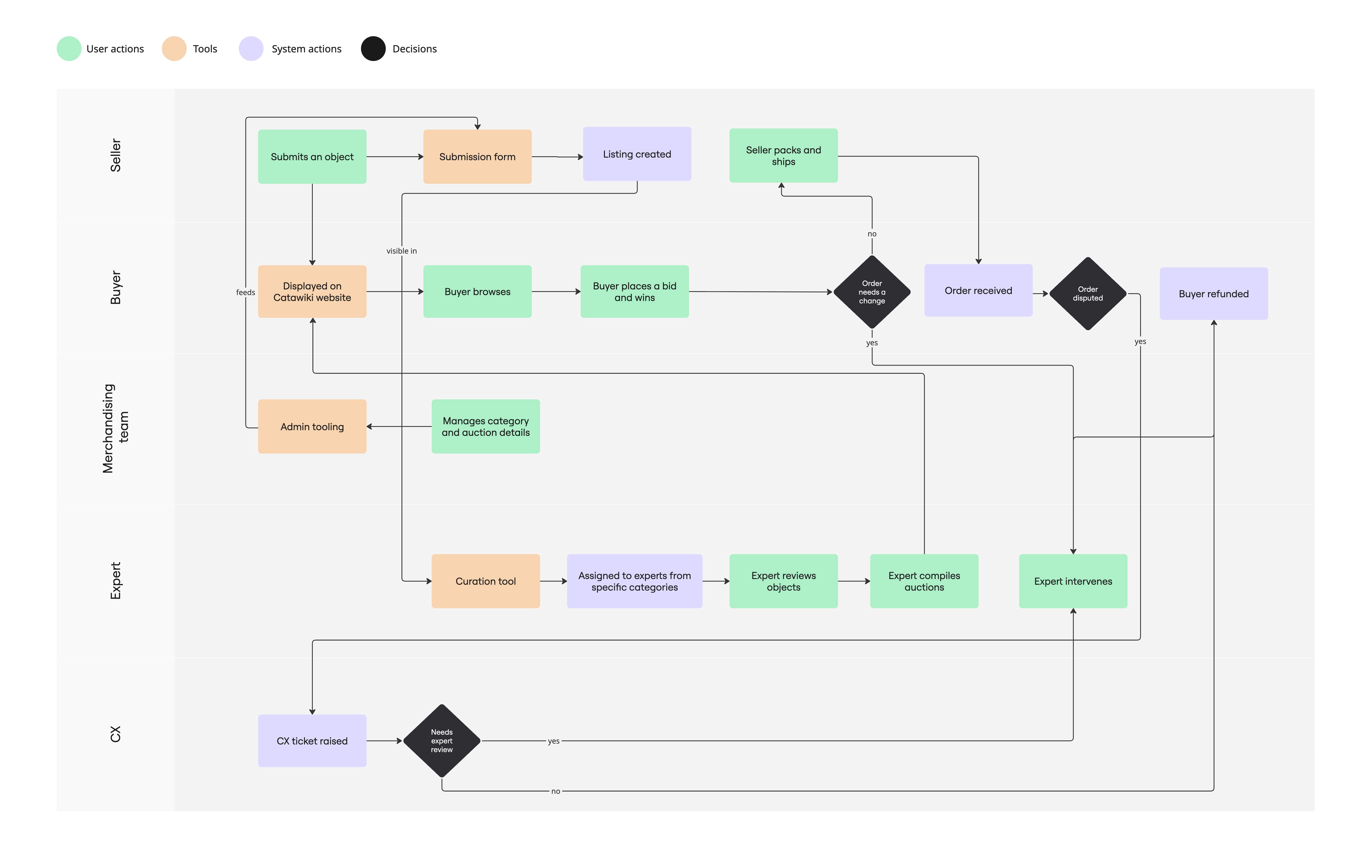
A simplified systems map of entities and tools involved
A simplified systems map of entities and tools involved
A simplified systems map of entities and tools involved
A simplified systems map of entities and tools involved
Exploring directions & learning from failure
We began by testing an object search that still exposed category information. We believed this would maintain transparency for pro sellers while simplifying discovery. We A/B tested it against the existing category-first flow and it performed worse. Over 20% of searches returned zero results and CES dropped by 3 points
Through deeper analysis, we uncovered that object-to-category mapping was far more complex than anticipated. A single object, like a painting, could belong to 17 categories. The result list became overwhelming. Sellers either scrolled through long lists or selected the closest approximation. Exposing category logic added cognitive load rather than reducing it. That failure was pivotal. It clarified that category complexity needed to be handled behind the scenes.
Exploring directions & learning from failure
We began by testing an object search that still exposed category information. We believed this would maintain transparency for pro sellers while simplifying discovery. We A/B tested it against the existing category-first flow and it performed worse. Over 20% of searches returned zero results and CES dropped by 3 points
Through deeper analysis, we uncovered that object-to-category mapping was far more complex than anticipated. A single object, like a painting, could belong to 17 categories. The result list became overwhelming. Sellers either scrolled through long lists or selected the closest approximation. Exposing category logic added cognitive load rather than reducing it. That failure was pivotal. It clarified that category complexity needed to be handled behind the scenes.
Exploring directions & learning from failure
We began by testing an object search that still exposed category information. We believed this would maintain transparency for pro sellers while simplifying discovery. We A/B tested it against the existing category-first flow and it performed worse. Over 20% of searches returned zero results and CES dropped by 3 points
Through deeper analysis, we uncovered that object-to-category mapping was far more complex than anticipated. A single object, like a painting, could belong to 17 categories. The result list became overwhelming. Sellers either scrolled through long lists or selected the closest approximation. Exposing category logic added cognitive load rather than reducing it. That failure was pivotal. It clarified that category complexity needed to be handled behind the scenes.
Exploring directions & learning from failure
We began by testing an object search that still exposed category information. We believed this would maintain transparency for pro sellers while simplifying discovery. We A/B tested it against the existing category-first flow and it performed worse. Over 20% of searches returned zero results and CES dropped by 3 points
Through deeper analysis, we uncovered that object-to-category mapping was far more complex than anticipated. A single object, like a painting, could belong to 17 categories. The result list became overwhelming. Sellers either scrolled through long lists or selected the closest approximation. Exposing category logic added cognitive load rather than reducing it. That failure was pivotal. It clarified that category complexity needed to be handled behind the scenes.
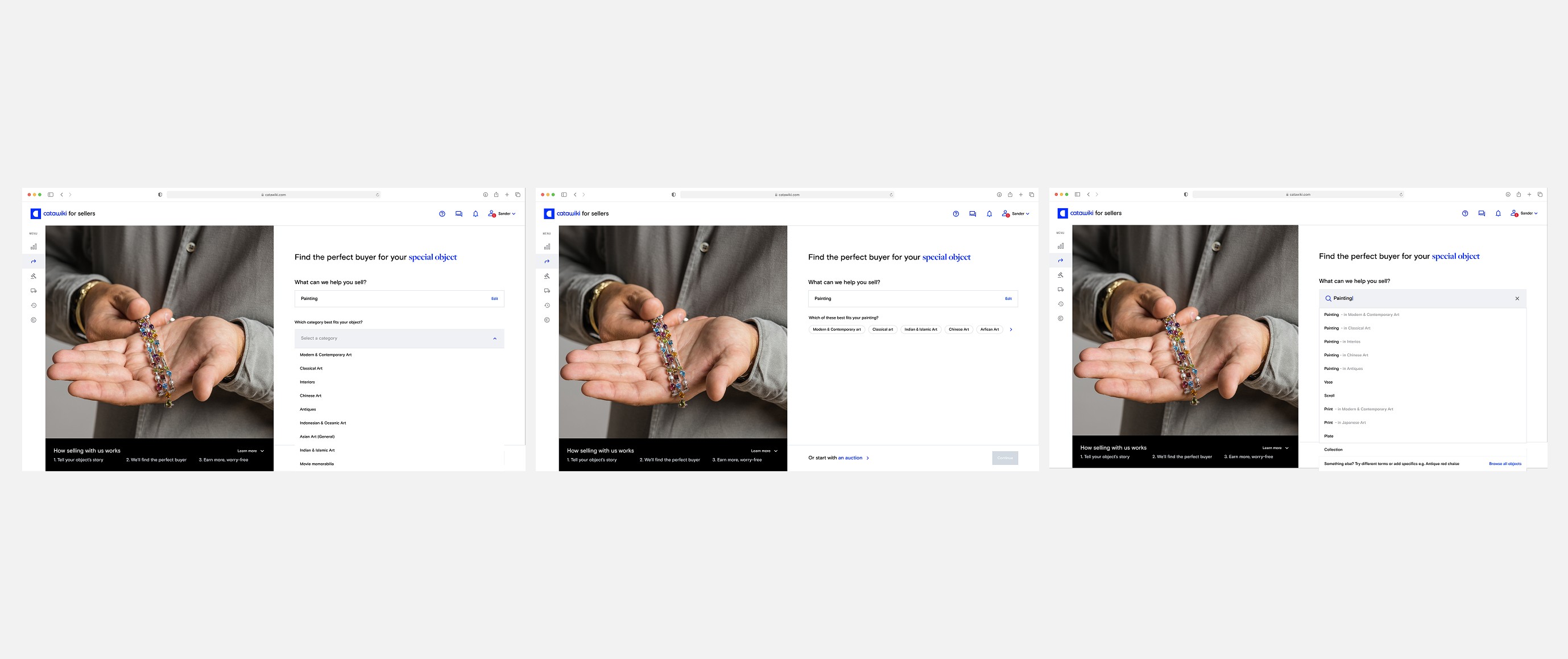
Earlier iterations of object selection
Earlier iterations of object selection
Earlier iterations of object selection
Earlier iterations of object selection
Through another round of iterations I arrived at the smart category selection. This work required deep partnership across functions. Catawiki experts helped validate category logic. Data science supported ranking accuracy. Commercial teams ensured merchandising needs were preserved.
Through another round of iterations I arrived at the smart category selection. This work required deep partnership across functions. Catawiki experts helped validate category logic. Data science supported ranking accuracy. Commercial teams ensured merchandising needs were preserved.
Through another round of iterations I arrived at the smart category selection. This work required deep partnership across functions. Catawiki experts helped validate category logic. Data science supported ranking accuracy. Commercial teams ensured merchandising needs were preserved.
Through another round of iterations I arrived at the smart category selection. This work required deep partnership across functions. Catawiki experts helped validate category logic. Data science supported ranking accuracy. Commercial teams ensured merchandising needs were preserved.
Finding patterns across key categories
I mapped object details (specs) across three high-volume categories (Fashion, Furniture, and Art), focusing on objects that were hardest to structure. This revealed recurring patterns that helped define consistent object fields across categories. I also grouped fields into anchor details and general details, allowing us to design clearer hierarchy and display logic.
Finding patterns across key categories
I mapped object details (specs) across three high-volume categories (Fashion, Furniture, and Art), focusing on objects that were hardest to structure. This revealed recurring patterns that helped define consistent object fields across categories. I also grouped fields into anchor details and general details, allowing us to design clearer hierarchy and display logic.
Finding patterns across key categories
I mapped object details (specs) across three high-volume categories (Fashion, Furniture, and Art), focusing on objects that were hardest to structure. This revealed recurring patterns that helped define consistent object fields across categories. I also grouped fields into anchor details and general details, allowing us to design clearer hierarchy and display logic.
Finding patterns across key categories
I mapped object details (specs) across three high-volume categories (Fashion, Furniture, and Art), focusing on objects that were hardest to structure. This revealed recurring patterns that helped define consistent object fields across categories. I also grouped fields into anchor details and general details, allowing us to design clearer hierarchy and display logic.
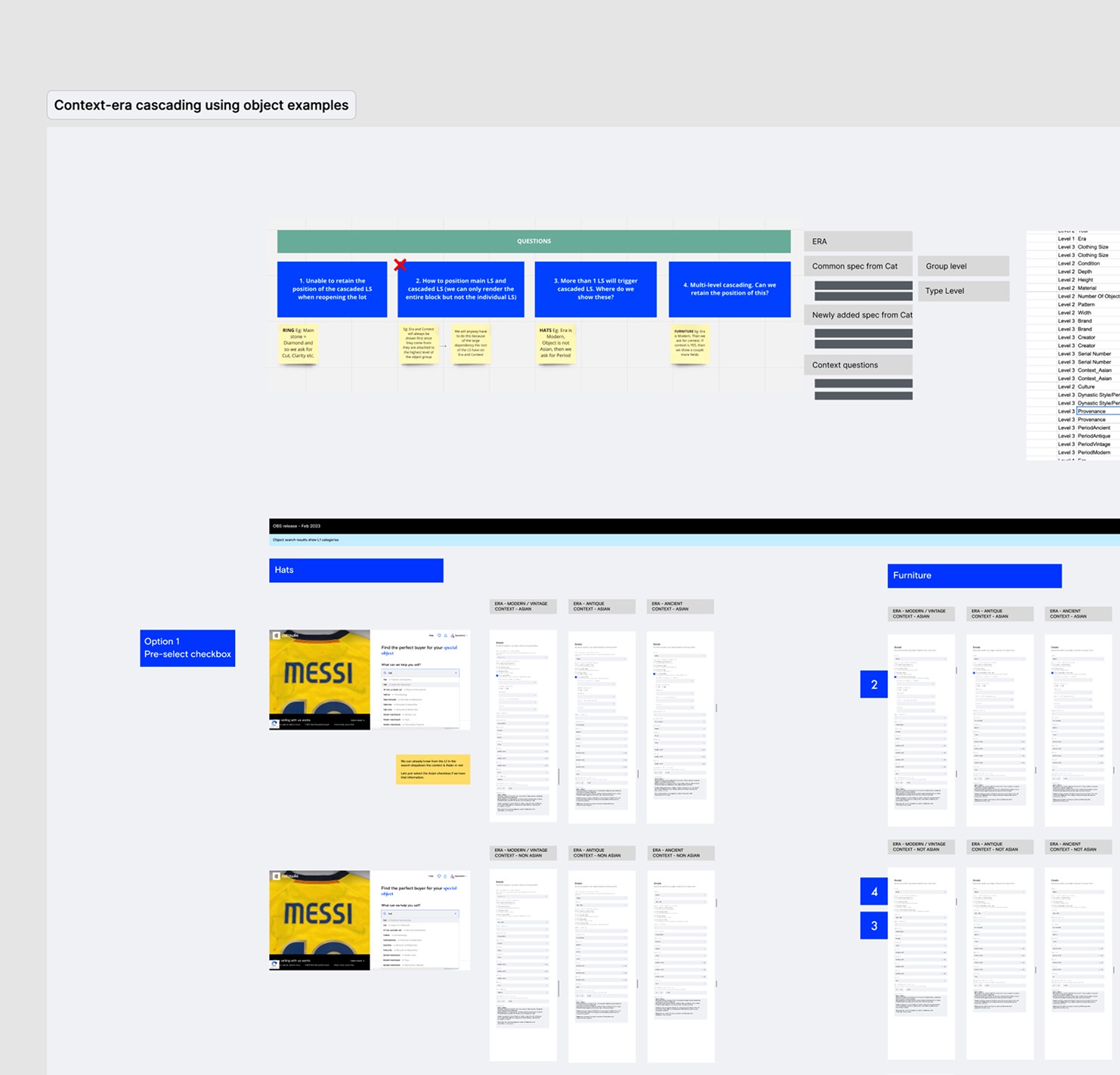
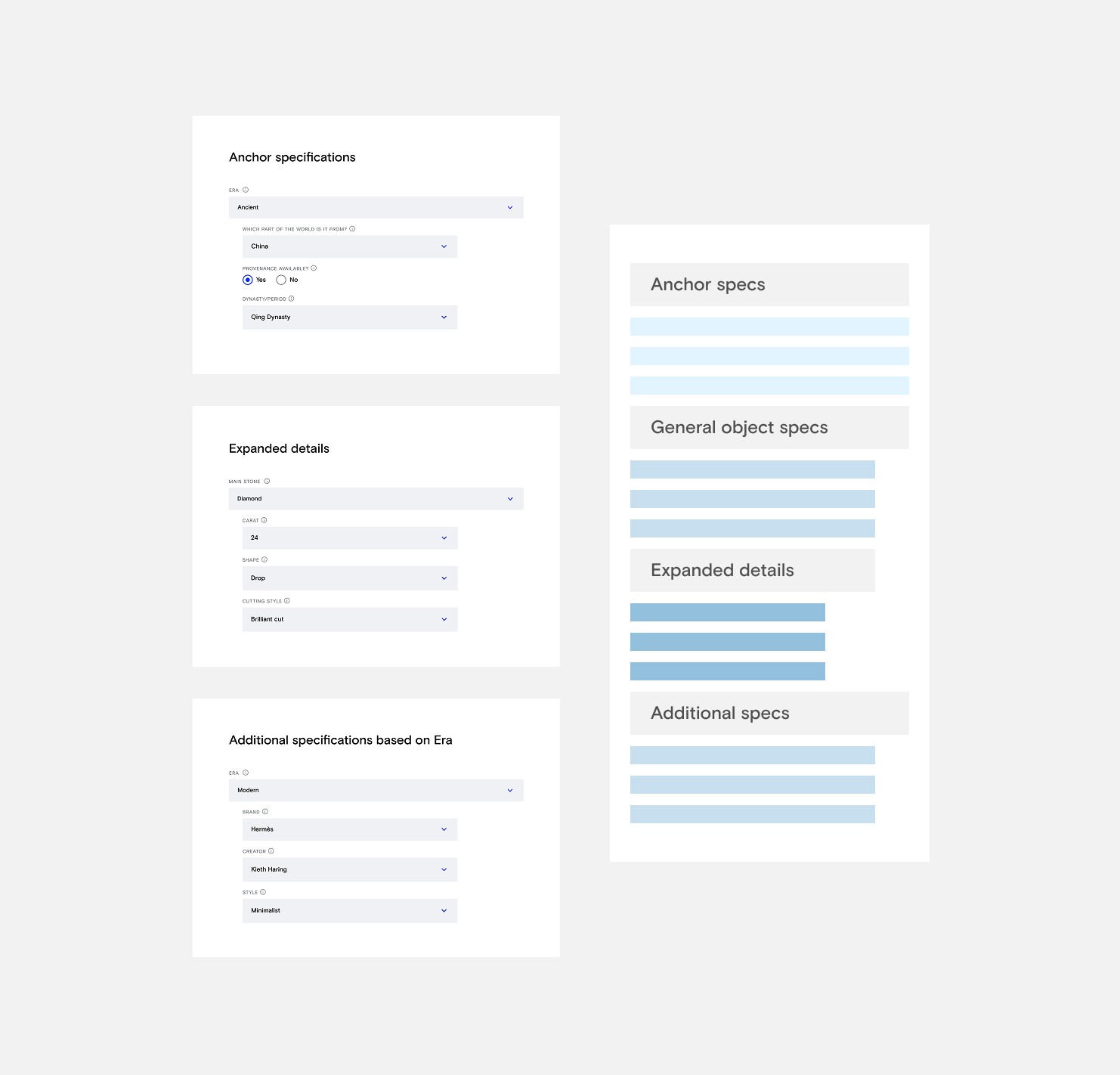
Object field mapping and heirarchy
Object field mapping and heirarchy
Object field mapping and heirarchy
Object field mapping and heirarchy
Beta testing to surface the real risks
Once we had a working second iteration, we opened the new flow to seven high-volume sellers for one week and interviewed them after to understand real-world friction before scale. The most critical issue we uncovered wasn’t the form or the object search, it was title generation.
In the old world, titles were generated based on the category an object was listed in. The same object could be described differently depending on where it lived. For example, a figure sold as a decorative object would emphasize the maker, while the same figure sold as an archaeological object would highlight the historic period. That nuance helped buyers scan and differentiate listings.
In the new object-first flow, each object initially had one title regardless of category, which made listings feel overly similar. Pro sellers immediately flagged this as a discoverability risk and they were right.
Beta testing to surface the real risks
Once we had a working second iteration, we opened the new flow to seven high-volume sellers for one week and interviewed them after to understand real-world friction before scale. The most critical issue we uncovered wasn’t the form or the object search, it was title generation.
In the old world, titles were generated based on the category an object was listed in. The same object could be described differently depending on where it lived. For example, a figure sold as a decorative object would emphasize the maker, while the same figure sold as an archaeological object would highlight the historic period. That nuance helped buyers scan and differentiate listings.
In the new object-first flow, each object initially had one title regardless of category, which made listings feel overly similar. Pro sellers immediately flagged this as a discoverability risk and they were right.
Beta testing to surface the real risks
Once we had a working second iteration, we opened the new flow to seven high-volume sellers for one week and interviewed them after to understand real-world friction before scale. The most critical issue we uncovered wasn’t the form or the object search, it was title generation.
In the old world, titles were generated based on the category an object was listed in. The same object could be described differently depending on where it lived. For example, a figure sold as a decorative object would emphasize the maker, while the same figure sold as an archaeological object would highlight the historic period. That nuance helped buyers scan and differentiate listings.
In the new object-first flow, each object initially had one title regardless of category, which made listings feel overly similar. Pro sellers immediately flagged this as a discoverability risk and they were right.
Beta testing to surface the real risks
Once we had a working second iteration, we opened the new flow to seven high-volume sellers for one week and interviewed them after to understand real-world friction before scale. The most critical issue we uncovered wasn’t the form or the object search, it was title generation.
In the old world, titles were generated based on the category an object was listed in. The same object could be described differently depending on where it lived. For example, a figure sold as a decorative object would emphasize the maker, while the same figure sold as an archaeological object would highlight the historic period. That nuance helped buyers scan and differentiate listings.
In the new object-first flow, each object initially had one title regardless of category, which made listings feel overly similar. Pro sellers immediately flagged this as a discoverability risk and they were right.
Adding specificity without adding complexity
First, we used the object-to-category mapping we built in iteration two to introduce conditional title logic for the categories where nuance mattered most. That allowed the system to generate differentiated titles again without pushing complexity back onto sellers
Second, during the beta we noticed sellers were manually editing titles to add missing detail. That was a strong signal: the system wasn’t capturing enough specificity early on. To address this, we added an optional “narrow it down” step during object selection so instead of “ring,” sellers could choose “engagement ring,” and the rest of the flow could adapt accordingly. This kept the experience light for casual sellers while giving power sellers a path to be precise.
Adding specificity without adding complexity
First, we used the object-to-category mapping we built in iteration two to introduce conditional title logic for the categories where nuance mattered most. That allowed the system to generate differentiated titles again without pushing complexity back onto sellers
Second, during the beta we noticed sellers were manually editing titles to add missing detail. That was a strong signal: the system wasn’t capturing enough specificity early on. To address this, we added an optional “narrow it down” step during object selection so instead of “ring,” sellers could choose “engagement ring,” and the rest of the flow could adapt accordingly. This kept the experience light for casual sellers while giving power sellers a path to be precise.
Adding specificity without adding complexity
First, we used the object-to-category mapping we built in iteration two to introduce conditional title logic for the categories where nuance mattered most. That allowed the system to generate differentiated titles again without pushing complexity back onto sellers
Second, during the beta we noticed sellers were manually editing titles to add missing detail. That was a strong signal: the system wasn’t capturing enough specificity early on. To address this, we added an optional “narrow it down” step during object selection so instead of “ring,” sellers could choose “engagement ring,” and the rest of the flow could adapt accordingly. This kept the experience light for casual sellers while giving power sellers a path to be precise.
Adding specificity without adding complexity
First, we used the object-to-category mapping we built in iteration two to introduce conditional title logic for the categories where nuance mattered most. That allowed the system to generate differentiated titles again without pushing complexity back onto sellers
Second, during the beta we noticed sellers were manually editing titles to add missing detail. That was a strong signal: the system wasn’t capturing enough specificity early on. To address this, we added an optional “narrow it down” step during object selection so instead of “ring,” sellers could choose “engagement ring,” and the rest of the flow could adapt accordingly. This kept the experience light for casual sellers while giving power sellers a path to be precise.
Reflection
Reflection
Reflection
Reflection
Top learning
Looking back, the strongest part of this project was how tightly we aligned product, data, and expert teams. This wasn’t just a UX problem, it was a structural shift that touched category strategy, internal tooling, and marketplace logic. Continuously looping in those teams early helped us uncover edge cases long before they became technical blockers.
Top learning
Looking back, the strongest part of this project was how tightly we aligned product, data, and expert teams. This wasn’t just a UX problem, it was a structural shift that touched category strategy, internal tooling, and marketplace logic. Continuously looping in those teams early helped us uncover edge cases long before they became technical blockers.
Top learning
Looking back, the strongest part of this project was how tightly we aligned product, data, and expert teams. This wasn’t just a UX problem, it was a structural shift that touched category strategy, internal tooling, and marketplace logic. Continuously looping in those teams early helped us uncover edge cases long before they became technical blockers.
Top learning
Looking back, the strongest part of this project was how tightly we aligned product, data, and expert teams. This wasn’t just a UX problem, it was a structural shift that touched category strategy, internal tooling, and marketplace logic. Continuously looping in those teams early helped us uncover edge cases long before they became technical blockers.
What I'd do differently
I would introduce lightweight prototypes for the trickiest parts (like object-to-category mapping and title generation) get qualitative signals much earlier in the process. These were the components with the largest failure potential, testing earlier than the beta roll out could have saved iteration cycles.
What I'd do differently
I would introduce lightweight prototypes for the trickiest parts (like object-to-category mapping and title generation) get qualitative signals much earlier in the process. These were the components with the largest failure potential, testing earlier than the beta roll out could have saved iteration cycles.
What I'd do differently
I would introduce lightweight prototypes for the trickiest parts (like object-to-category mapping and title generation) get qualitative signals much earlier in the process. These were the components with the largest failure potential, testing earlier than the beta roll out could have saved iteration cycles.
What I'd do differently
I would introduce lightweight prototypes for the trickiest parts (like object-to-category mapping and title generation) get qualitative signals much earlier in the process. These were the components with the largest failure potential, testing earlier than the beta roll out could have saved iteration cycles.

