EMPLOYER
CATAWIKI
PLATFORM:
WEB, IOS, ANDROID
AREA:
DESIGN, STRATEGY, RESEARCH
YEAR:
2024

Flexible seller registration
Helping sellers sell faster while protecting buyer trust
Background
Catawiki is an online auction marketplace for unique objects, from classic cars to rare coins. In 2023, the company aimed to scale its seller base significantly. However, only 1 in 3 sellers completed identity verification, a legal requirement before their object could be placed in auction. Friction at the top of the funnel directly constrained inventory growth. Sellers were dropping off before reaching the point where they could actually sell. This was a strategic bottleneck impacting supply, compliance, and trust.
Background
Catawiki is an online auction marketplace for unique objects, from classic cars to rare coins. In 2023, the company aimed to scale its seller base significantly. However, only 1 in 3 sellers completed identity verification, a legal requirement before their object could be placed in auction. Friction at the top of the funnel directly constrained inventory growth. Sellers were dropping off before reaching the point where they could actually sell. This was a strategic bottleneck impacting supply, compliance, and trust.
Background
Catawiki is an online auction marketplace for unique objects, from classic cars to rare coins. In 2023, the company aimed to scale its seller base significantly. However, only 1 in 3 sellers completed identity verification, a legal requirement before their object could be placed in auction. Friction at the top of the funnel directly constrained inventory growth. Sellers were dropping off before reaching the point where they could actually sell. This was a strategic bottleneck impacting supply, compliance, and trust.
Background
Catawiki is an online auction marketplace for unique objects, from classic cars to rare coins. In 2023, the company aimed to scale its seller base significantly. However, only 1 in 3 sellers completed identity verification, a legal requirement before their object could be placed in auction. Friction at the top of the funnel directly constrained inventory growth. Sellers were dropping off before reaching the point where they could actually sell. This was a strategic bottleneck impacting supply, compliance, and trust.

Challenge
Redesign the verification experience in a way that increases completion rates without weakening buyer trust, compromising legal compliance, or increasing fraud risk.
Our goal was to improve seller momentum and remove unnecessary friction, while maintaining the integrity and safety of the marketplace.
My role: I led the end-to-end design of the verification experience, defining the north star with the core team and driving it from concept through rollout.
Challenge
Redesign the verification experience in a way that increases completion rates without weakening buyer trust, compromising legal compliance, or increasing fraud risk.
Our goal was to improve seller momentum and remove unnecessary friction, while maintaining the integrity and safety of the marketplace.
My role: I led the end-to-end design of the verification experience, defining the north star with the core team and driving it from concept through rollout.
Challenge
Redesign the verification experience in a way that increases completion rates without weakening buyer trust, compromising legal compliance, or increasing fraud risk.
Our goal was to improve seller momentum and remove unnecessary friction, while maintaining the integrity and safety of the marketplace.
My role: I led the end-to-end design of the verification experience, defining the north star with the core team and driving it from concept through rollout.
Challenge
Redesign the verification experience in a way that increases completion rates without weakening buyer trust, compromising legal compliance, or increasing fraud risk.
Our goal was to improve seller momentum and remove unnecessary friction, while maintaining the integrity and safety of the marketplace.
My role: I led the end-to-end design of the verification experience, defining the north star with the core team and driving it from concept through rollout.

Reframing the problem
Instead of asking, “How can we simplify verification?” I reframed the challenge as: How might we align verification with moments when sellers are most motivated? This was rooted in the Fogg behavior model.
Reframing the problem
Instead of asking, “How can we simplify verification?” I reframed the challenge as: How might we align verification with moments when sellers are most motivated? This was rooted in the Fogg behavior model.
Reframing the problem
Instead of asking, “How can we simplify verification?” I reframed the challenge as: How might we align verification with moments when sellers are most motivated? This was rooted in the Fogg behavior model.
Reframing the problem
Instead of asking, “How can we simplify verification?” I reframed the challenge as: How might we align verification with moments when sellers are most motivated? This was rooted in the Fogg behavior model.
Designing for motivation and timing
Grounded in behavioral principles, I redesigned verification as something distributed across the journey rather than concentrated at the start.
If we could time requests around moments of high motivation when sellers saw value or were close to payout we could reduce drop-off without removing necessary safeguards.
Designing for motivation and timing
Grounded in behavioral principles, I redesigned verification as something distributed across the journey rather than concentrated at the start.
If we could time requests around moments of high motivation when sellers saw value or were close to payout we could reduce drop-off without removing necessary safeguards.
Designing for motivation and timing
Grounded in behavioral principles, I redesigned verification as something distributed across the journey rather than concentrated at the start.
If we could time requests around moments of high motivation when sellers saw value or were close to payout we could reduce drop-off without removing necessary safeguards.
Designing for motivation and timing
Grounded in behavioral principles, I redesigned verification as something distributed across the journey rather than concentrated at the start.
If we could time requests around moments of high motivation when sellers saw value or were close to payout we could reduce drop-off without removing necessary safeguards.
Get straight to selling
Sellers could begin by listing their object immediately. After selecting what they wanted to sell, we showed similar sold items to reinforce value, followed by a simple sign-up. Instead of front-loading personal data collection, we distributed key steps throughout the journey at moments that felt more natural and relevant.
Get straight to selling
Sellers could begin by listing their object immediately. After selecting what they wanted to sell, we showed similar sold items to reinforce value, followed by a simple sign-up. Instead of front-loading personal data collection, we distributed key steps throughout the journey at moments that felt more natural and relevant.
Get straight to selling
Sellers could begin by listing their object immediately. After selecting what they wanted to sell, we showed similar sold items to reinforce value, followed by a simple sign-up. Instead of front-loading personal data collection, we distributed key steps throughout the journey at moments that felt more natural and relevant.
Get straight to selling
Sellers could begin by listing their object immediately. After selecting what they wanted to sell, we showed similar sold items to reinforce value, followed by a simple sign-up. Instead of front-loading personal data collection, we distributed key steps throughout the journey at moments that felt more natural and relevant.
Ask at the right moment
We aligned verification requests with meaningful milestones. Address information was requested at the shipping stage. Payment details and IBAN verification were requested when payout was due, precisely when sellers were most motivated to complete the step. Before redirecting to third-party verification, we clearly explained why it was needed and what to expect next. The goal was to make registration feel intentional and predictable.
Ask at the right moment
We aligned verification requests with meaningful milestones. Address information was requested at the shipping stage. Payment details and IBAN verification were requested when payout was due, precisely when sellers were most motivated to complete the step. Before redirecting to third-party verification, we clearly explained why it was needed and what to expect next. The goal was to make registration feel intentional and predictable.
Ask at the right moment
We aligned verification requests with meaningful milestones. Address information was requested at the shipping stage. Payment details and IBAN verification were requested when payout was due, precisely when sellers were most motivated to complete the step. Before redirecting to third-party verification, we clearly explained why it was needed and what to expect next. The goal was to make registration feel intentional and predictable.
Ask at the right moment
We aligned verification requests with meaningful milestones. Address information was requested at the shipping stage. Payment details and IBAN verification were requested when payout was due, precisely when sellers were most motivated to complete the step. Before redirecting to third-party verification, we clearly explained why it was needed and what to expect next. The goal was to make registration feel intentional and predictable.
Nudge rather than block
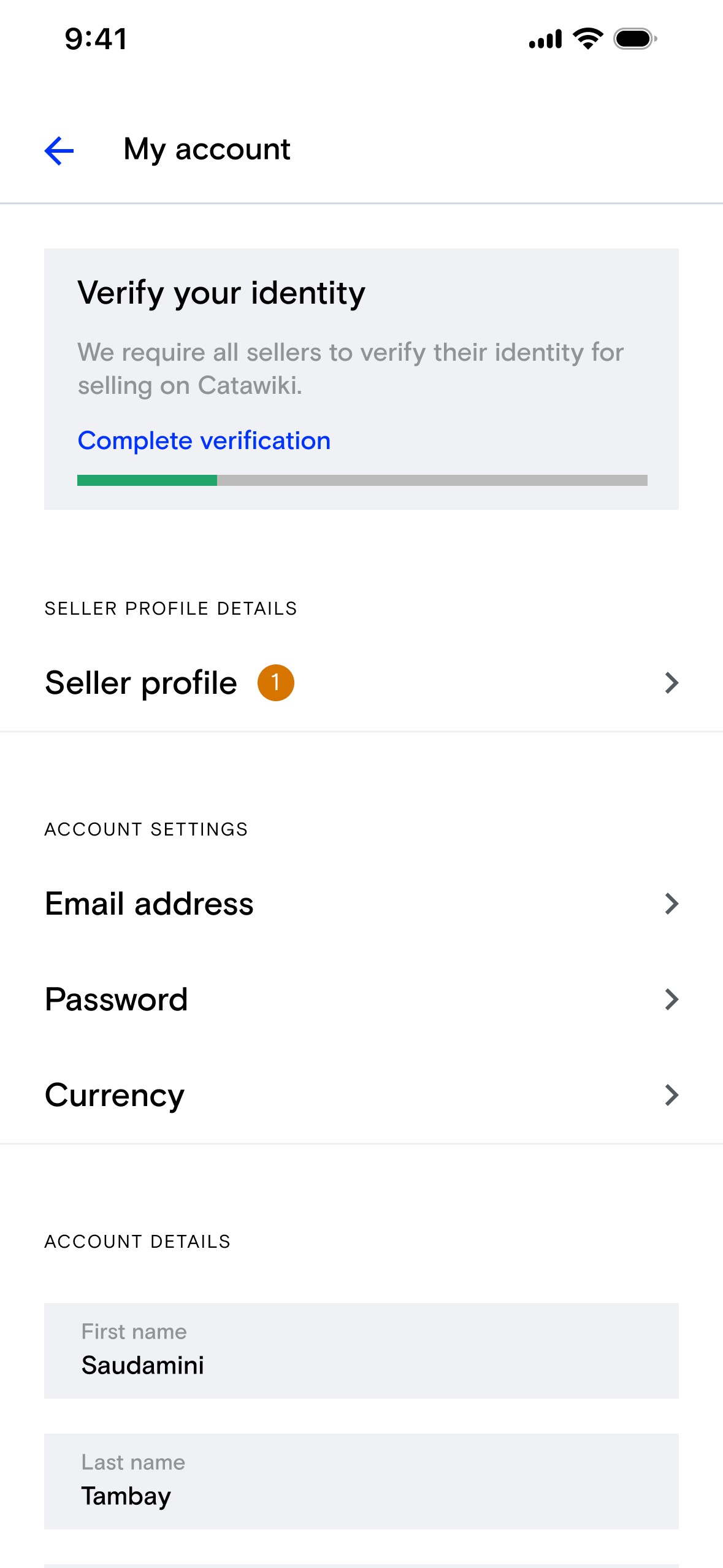
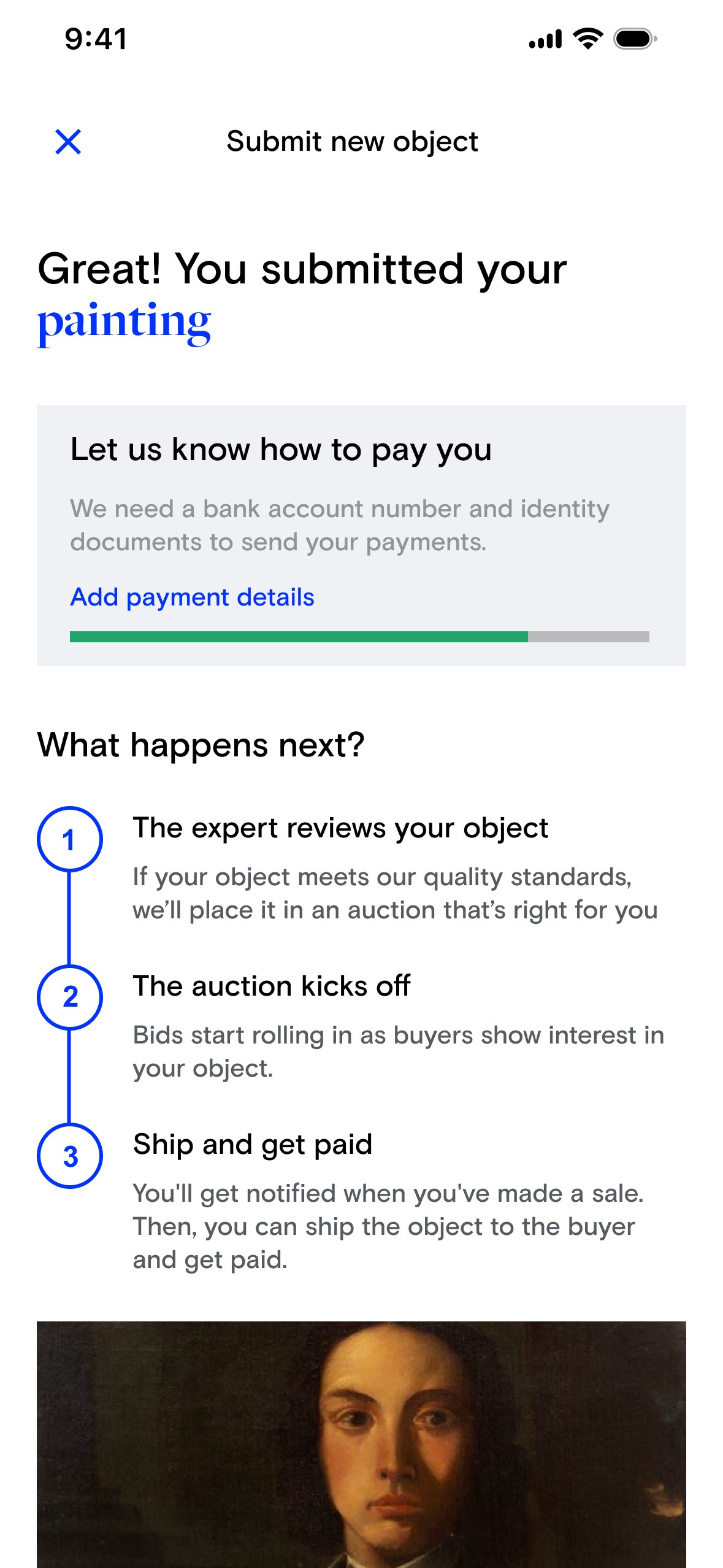
Rather than blocking sellers upfront, I introduced a number of contextual nudges based on the urgency of verification. Unverified sellers were reminded at key moments throughout the journey and could choose to complete full verification while waiting for their object to be approved. These nudges only appeared after their first submission. A few examples below:
Nudge rather than block
Rather than blocking sellers upfront, I introduced a number of contextual nudges based on the urgency of verification. Unverified sellers were reminded at key moments throughout the journey and could choose to complete full verification while waiting for their object to be approved. These nudges only appeared after their first submission. A few examples below:
Nudge rather than block
Rather than blocking sellers upfront, I introduced a number of contextual nudges based on the urgency of verification. Unverified sellers were reminded at key moments throughout the journey and could choose to complete full verification while waiting for their object to be approved. These nudges only appeared after their first submission. A few examples below:
Nudge rather than block
Rather than blocking sellers upfront, I introduced a number of contextual nudges based on the urgency of verification. Unverified sellers were reminded at key moments throughout the journey and could choose to complete full verification while waiting for their object to be approved. These nudges only appeared after their first submission. A few examples below:
Use data to reduce friction
We leveraged existing data to guide sellers more intelligently. If sellers attempted to submit objects from unsupported countries, we informed them early to prevent wasted effort. Information collected along the journey was also used to pre-fill Stripe forms, reducing duplication and streamlining completion.
Use data to reduce friction
We leveraged existing data to guide sellers more intelligently. If sellers attempted to submit objects from unsupported countries, we informed them early to prevent wasted effort. Information collected along the journey was also used to pre-fill Stripe forms, reducing duplication and streamlining completion.
Use data to reduce friction
We leveraged existing data to guide sellers more intelligently. If sellers attempted to submit objects from unsupported countries, we informed them early to prevent wasted effort. Information collected along the journey was also used to pre-fill Stripe forms, reducing duplication and streamlining completion.
Use data to reduce friction
We leveraged existing data to guide sellers more intelligently. If sellers attempted to submit objects from unsupported countries, we informed them early to prevent wasted effort. Information collected along the journey was also used to pre-fill Stripe forms, reducing duplication and streamlining completion.
Impact
Impact
Impact
Impact
+8.3%
Sellers with approved item YOY
+5.4%
Sellers with first item in auction
-40%
Unverified seller item returns
+8.3%
Sellers with approved item YOY
+5.4%
Sellers with first item in auction
-40%
Unverified seller item returns
+8.3%
Sellers with approved item YOY
+5.4%
Sellers with first item in auction
-40%
Unverified seller item returns
+8.3%
Sellers with approved item YOY
+5.4%
Sellers with first item in auction
-40%
Unverified seller item returns
Cruicial decisions that led me to the final result
Cruicial decisions that led me to the final result
Cruicial decisions that led me to the final result
Cruicial decisions that led me to the final result
Understanding what we were really asking
Verification had become a catch-all for data collection. Before redesigning anything, I worked to understand why each data point was required, who used it, and when it was actually needed.
We discovered that much of the information gathered at registration wasn’t inherently tied to that moment it had simply accumulated there over time.
I mapped the seller journey and identified high-motivation moments e.g. approval, sale, payout, shipping and redistributed data collection accordingly. Verification shifted from a single gate to a distributed system.
Understanding what we were really asking
Verification had become a catch-all for data collection. Before redesigning anything, I worked to understand why each data point was required, who used it, and when it was actually needed.
We discovered that much of the information gathered at registration wasn’t inherently tied to that moment it had simply accumulated there over time.
I mapped the seller journey and identified high-motivation moments e.g. approval, sale, payout, shipping and redistributed data collection accordingly. Verification shifted from a single gate to a distributed system.
Understanding what we were really asking
Verification had become a catch-all for data collection. Before redesigning anything, I worked to understand why each data point was required, who used it, and when it was actually needed.
We discovered that much of the information gathered at registration wasn’t inherently tied to that moment it had simply accumulated there over time.
I mapped the seller journey and identified high-motivation moments e.g. approval, sale, payout, shipping and redistributed data collection accordingly. Verification shifted from a single gate to a distributed system.
Understanding what we were really asking
Verification had become a catch-all for data collection. Before redesigning anything, I worked to understand why each data point was required, who used it, and when it was actually needed.
We discovered that much of the information gathered at registration wasn’t inherently tied to that moment it had simply accumulated there over time.
I mapped the seller journey and identified high-motivation moments e.g. approval, sale, payout, shipping and redistributed data collection accordingly. Verification shifted from a single gate to a distributed system.
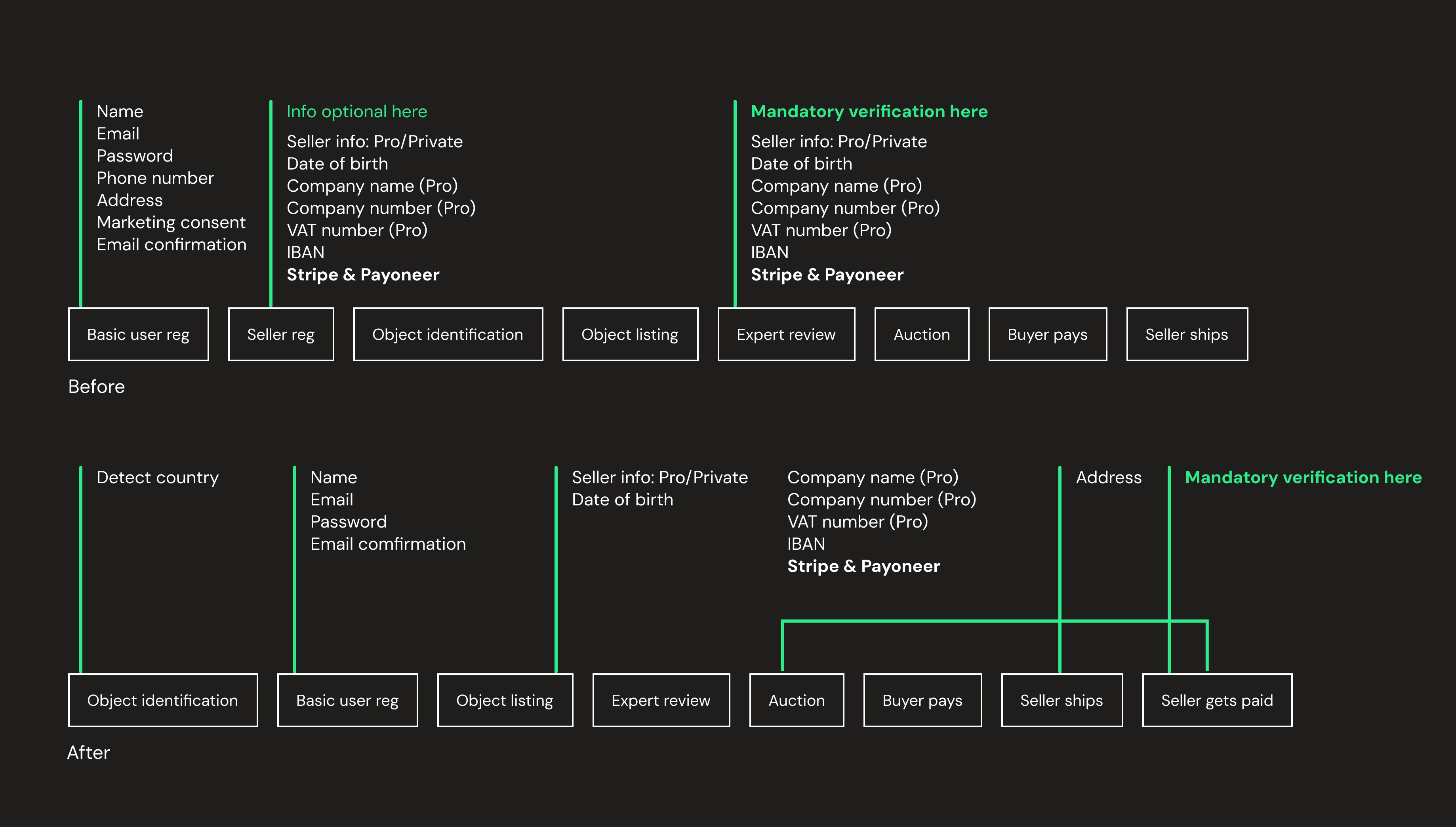
Before and after state of the data gathered
Before and after state of the data gathered
Before and after state of the data gathered
Before and after state of the data gathered
Identifying high motivation moments
Prompts and communication were critical to the success of this project. Once we identified the highest motivation moments in the seller journey, I partnered with UX Writing to redesign our email communication around them.
I facilitated a focused workshop to audit key touch-points, refine unclear messaging, and introduce new emails where needed. The goal was to inform the seller at the right time and reduce uncertainty throughout the journey.
Identifying high motivation moments
Prompts and communication were critical to the success of this project. Once we identified the highest motivation moments in the seller journey, I partnered with UX Writing to redesign our email communication around them.
I facilitated a focused workshop to audit key touch-points, refine unclear messaging, and introduce new emails where needed. The goal was to inform the seller at the right time and reduce uncertainty throughout the journey.
Identifying high motivation moments
Prompts and communication were critical to the success of this project. Once we identified the highest motivation moments in the seller journey, I partnered with UX Writing to redesign our email communication around them.
I facilitated a focused workshop to audit key touch-points, refine unclear messaging, and introduce new emails where needed. The goal was to inform the seller at the right time and reduce uncertainty throughout the journey.
Identifying high motivation moments
Prompts and communication were critical to the success of this project. Once we identified the highest motivation moments in the seller journey, I partnered with UX Writing to redesign our email communication around them.
I facilitated a focused workshop to audit key touch-points, refine unclear messaging, and introduce new emails where needed. The goal was to inform the seller at the right time and reduce uncertainty throughout the journey.
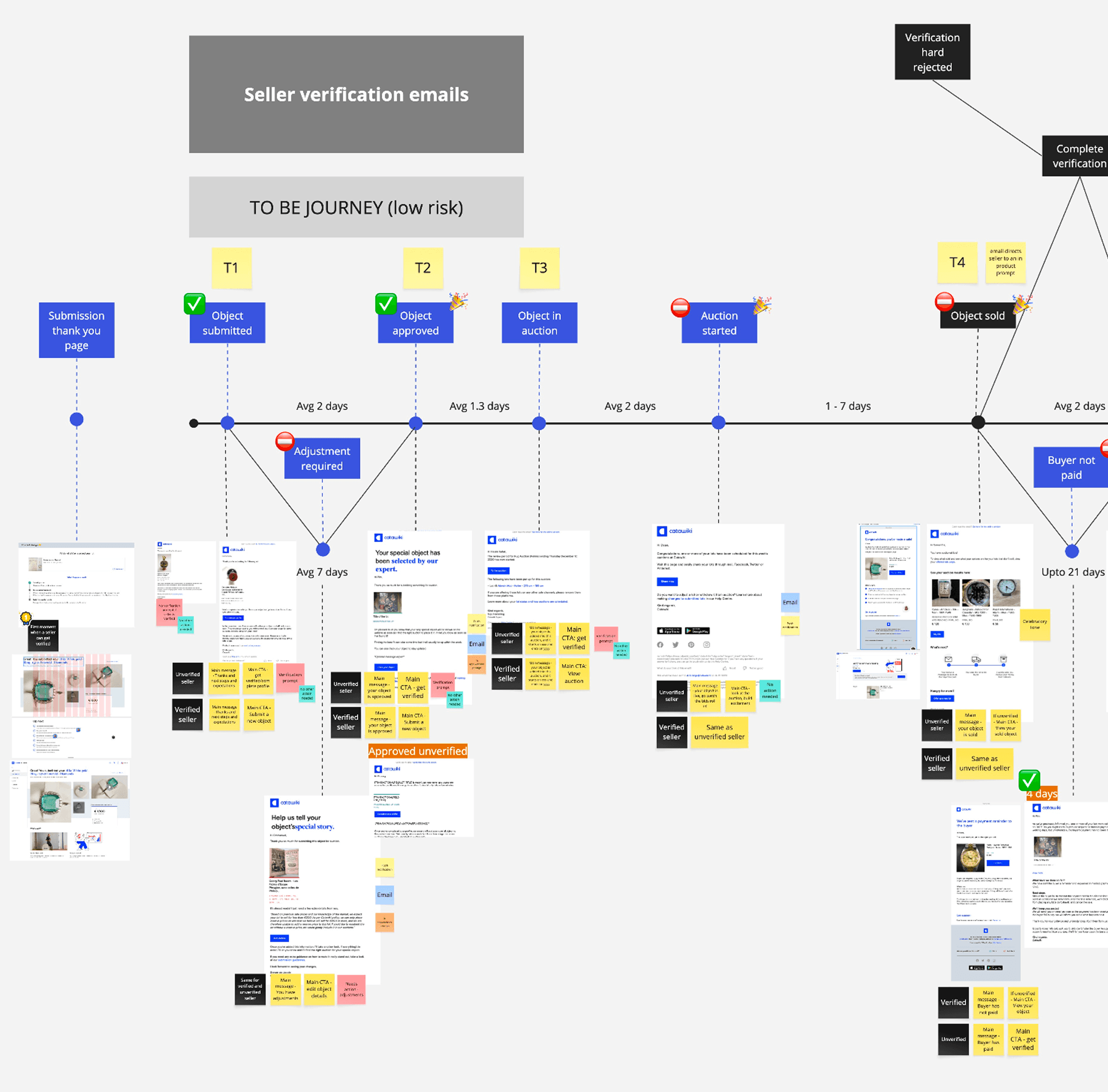
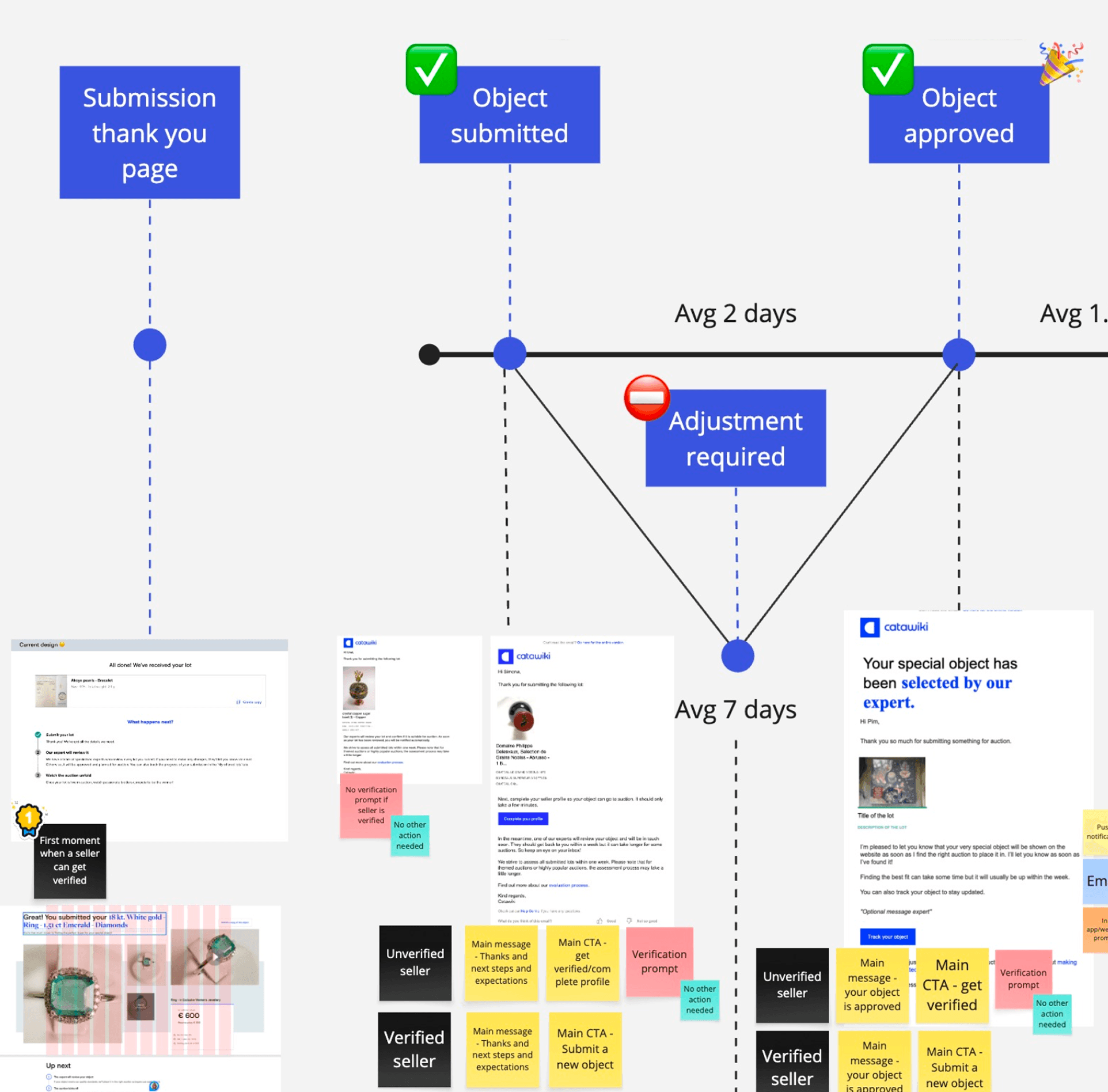
Screenshots of the communication workshop board
Screenshots of the communication workshop board
Screenshots of the communication workshop board
Screenshots of the communication workshop board
Establishing shared principles
To guide decisions across teams and phases, I defined five principles: seamless, guiding, incentivizing, trusting, and ongoing. Two became especially important.
Trusting meant designing for legitimate users first, not assuming fraud by default. We avoided adding unnecessary friction to “weed out” bad actors.
Ongoing reframed verification as something that evolves throughout the seller relationship, rather than a one-time hurdle at sign-up.
These principles helped us evaluate trade-offs consistently as complexity increased.
Establishing shared principles
To guide decisions across teams and phases, I defined five principles: seamless, guiding, incentivizing, trusting, and ongoing. Two became especially important.
Trusting meant designing for legitimate users first, not assuming fraud by default. We avoided adding unnecessary friction to “weed out” bad actors.
Ongoing reframed verification as something that evolves throughout the seller relationship, rather than a one-time hurdle at sign-up.
These principles helped us evaluate trade-offs consistently as complexity increased.
Establishing shared principles
To guide decisions across teams and phases, I defined five principles: seamless, guiding, incentivizing, trusting, and ongoing. Two became especially important.
Trusting meant designing for legitimate users first, not assuming fraud by default. We avoided adding unnecessary friction to “weed out” bad actors.
Ongoing reframed verification as something that evolves throughout the seller relationship, rather than a one-time hurdle at sign-up.
These principles helped us evaluate trade-offs consistently as complexity increased.
Establishing shared principles
To guide decisions across teams and phases, I defined five principles: seamless, guiding, incentivizing, trusting, and ongoing. Two became especially important.
Trusting meant designing for legitimate users first, not assuming fraud by default. We avoided adding unnecessary friction to “weed out” bad actors.
Ongoing reframed verification as something that evolves throughout the seller relationship, rather than a one-time hurdle at sign-up.
These principles helped us evaluate trade-offs consistently as complexity increased.
Defining and testing the northstar
Using internal research and competitor analysis, I defined a north star experience across Web, iOS, and Android. The core idea was to make the start easier for new sellers, ask for information at the right moments, and stay compliant.
A UX researcher and I tested the concept with recently onboarded sellers to compare perceived effort against the existing flow. This gave us an early signal before committing to phased rollout.
Defining and testing the northstar
Using internal research and competitor analysis, I defined a north star experience across Web, iOS, and Android. The core idea was to make the start easier for new sellers, ask for information at the right moments, and stay compliant.
A UX researcher and I tested the concept with recently onboarded sellers to compare perceived effort against the existing flow. This gave us an early signal before committing to phased rollout.
Defining and testing the northstar
Using internal research and competitor analysis, I defined a north star experience across Web, iOS, and Android. The core idea was to make the start easier for new sellers, ask for information at the right moments, and stay compliant.
A UX researcher and I tested the concept with recently onboarded sellers to compare perceived effort against the existing flow. This gave us an early signal before committing to phased rollout.
Defining and testing the northstar
Using internal research and competitor analysis, I defined a north star experience across Web, iOS, and Android. The core idea was to make the start easier for new sellers, ask for information at the right moments, and stay compliant.
A UX researcher and I tested the concept with recently onboarded sellers to compare perceived effort against the existing flow. This gave us an early signal before committing to phased rollout.
Balancing growth and risk
Moving verification later in the flow raised understandable concerns. What if high-risk sellers slipped through? What if buyer trust was affected?
Working closely with legal and data science, we analyzed fraud patterns and rejection rates. I defined separate flows for high-risk cases while allowing the majority of sellers to proceed with a smoother journey.
Balancing growth and risk
Moving verification later in the flow raised understandable concerns. What if high-risk sellers slipped through? What if buyer trust was affected?
Working closely with legal and data science, we analyzed fraud patterns and rejection rates. I defined separate flows for high-risk cases while allowing the majority of sellers to proceed with a smoother journey.
Balancing growth and risk
Moving verification later in the flow raised understandable concerns. What if high-risk sellers slipped through? What if buyer trust was affected?
Working closely with legal and data science, we analyzed fraud patterns and rejection rates. I defined separate flows for high-risk cases while allowing the majority of sellers to proceed with a smoother journey.
Balancing growth and risk
Moving verification later in the flow raised understandable concerns. What if high-risk sellers slipped through? What if buyer trust was affected?
Working closely with legal and data science, we analyzed fraud patterns and rejection rates. I defined separate flows for high-risk cases while allowing the majority of sellers to proceed with a smoother journey.
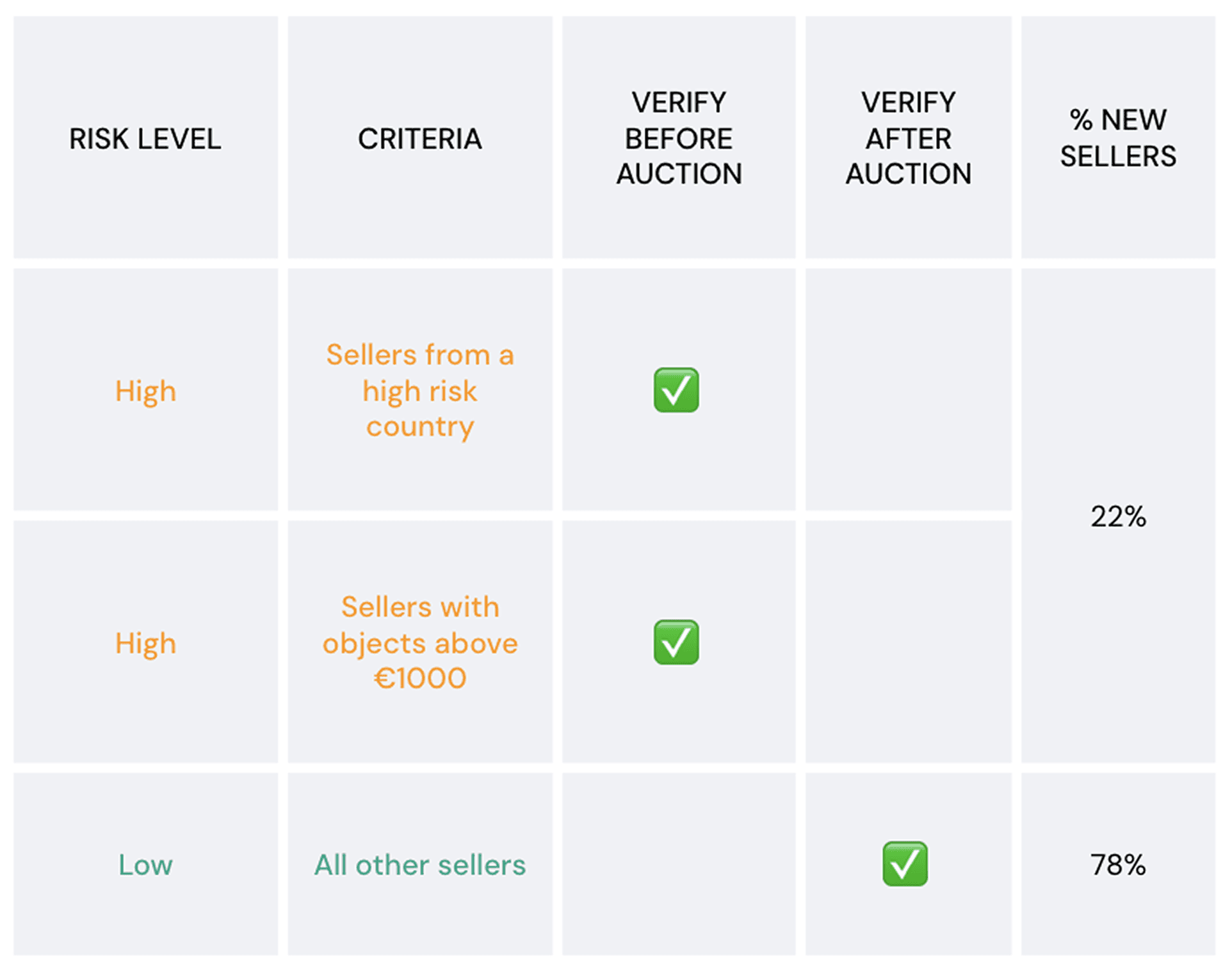
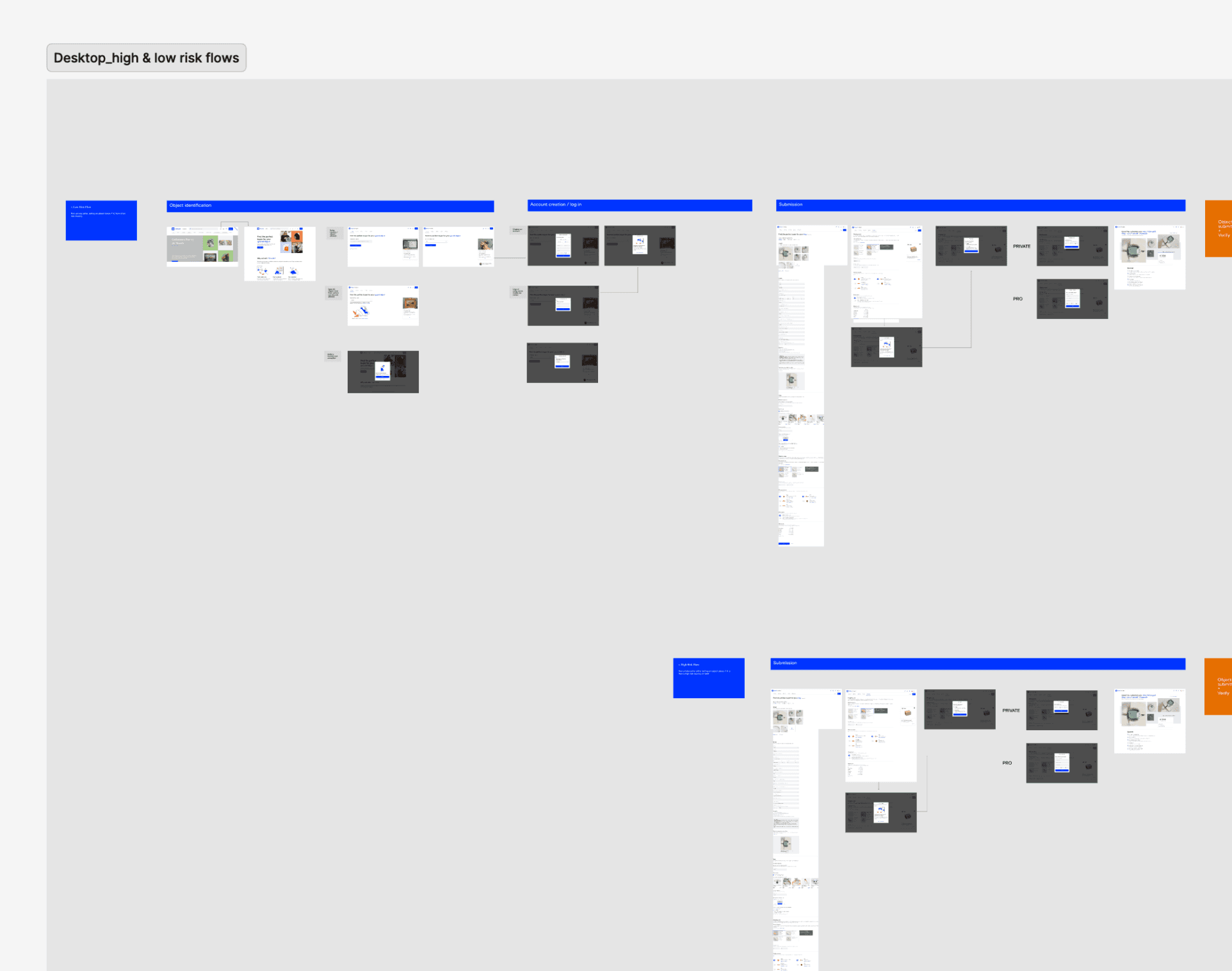
Screenshots of risk mapping results and high risk flows
Screenshots of risk mapping results and high risk flows
Screenshots of risk mapping results and high risk flows
Screenshots of risk mapping results and high risk flows
Making a data informed trade off
Preventing sellers from shipping before verification would slightly protect them. They’d retain ownership if third-party verification failed. However, it would create a poor buyer experience if a paid item was stuck in limbo while verification dragged on.
Allowing shipment meant we would temporarily hold seller funds if verification failed, but buyers would receive their object without delay. The only major issue would be if sellers got hard rejected.
On analyzing historical rejection data we found only around 11 hard rejections over 18 months, mostly tied to fraud. In the redesigned flow, expert review would filter out many of these cases even earlier.
Making a data informed trade off
Preventing sellers from shipping before verification would slightly protect them. They’d retain ownership if third-party verification failed. However, it would create a poor buyer experience if a paid item was stuck in limbo while verification dragged on.
Allowing shipment meant we would temporarily hold seller funds if verification failed, but buyers would receive their object without delay. The only major issue would be if sellers got hard rejected.
On analyzing historical rejection data we found only around 11 hard rejections over 18 months, mostly tied to fraud. In the redesigned flow, expert review would filter out many of these cases even earlier.
Making a data informed trade off
Preventing sellers from shipping before verification would slightly protect them. They’d retain ownership if third-party verification failed. However, it would create a poor buyer experience if a paid item was stuck in limbo while verification dragged on.
Allowing shipment meant we would temporarily hold seller funds if verification failed, but buyers would receive their object without delay. The only major issue would be if sellers got hard rejected.
On analyzing historical rejection data we found only around 11 hard rejections over 18 months, mostly tied to fraud. In the redesigned flow, expert review would filter out many of these cases even earlier.
Making a data informed trade off
Preventing sellers from shipping before verification would slightly protect them. They’d retain ownership if third-party verification failed. However, it would create a poor buyer experience if a paid item was stuck in limbo while verification dragged on.
Allowing shipment meant we would temporarily hold seller funds if verification failed, but buyers would receive their object without delay. The only major issue would be if sellers got hard rejected.
On analyzing historical rejection data we found only around 11 hard rejections over 18 months, mostly tied to fraud. In the redesigned flow, expert review would filter out many of these cases even earlier.
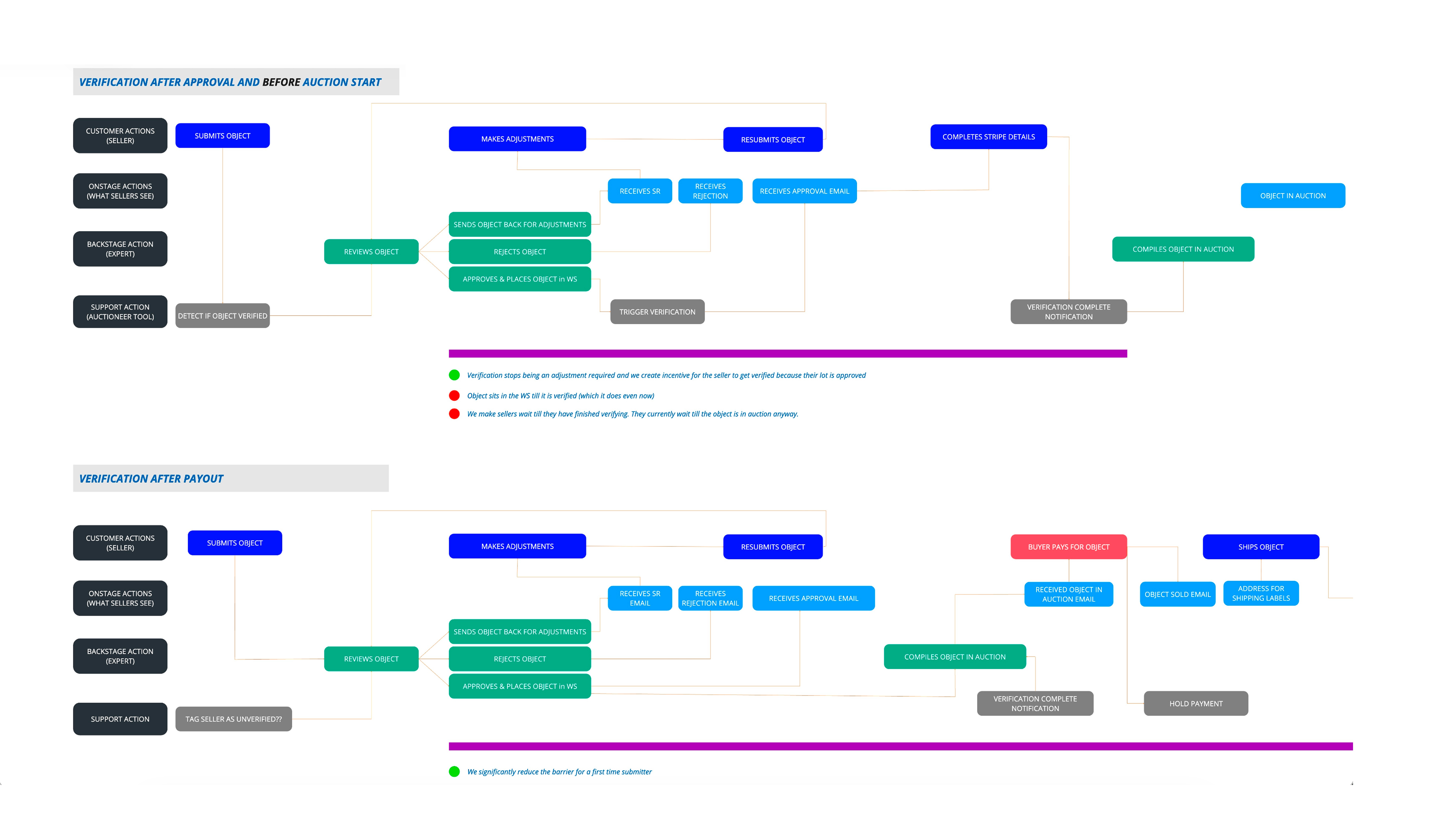
Payment flow mapping to understand intricacies and tradeoffs
Payment flow mapping to understand intricacies and tradeoffs
Payment flow mapping to understand intricacies and tradeoffs
Payment flow mapping to understand intricacies and tradeoffs
Reflection
Reflection
Reflection
Reflection
Top learning
Investing time early to clearly communicate the vision and involve teams pays off later. Bringing Engineering into design discussions from the start created shared ownership and reduced friction during delivery. Alignment upfront accelerated execution downstream.
Top learning
Investing time early to clearly communicate the vision and involve teams pays off later. Bringing Engineering into design discussions from the start created shared ownership and reduced friction during delivery. Alignment upfront accelerated execution downstream.
Top learning
Investing time early to clearly communicate the vision and involve teams pays off later. Bringing Engineering into design discussions from the start created shared ownership and reduced friction during delivery. Alignment upfront accelerated execution downstream.
Top learning
Investing time early to clearly communicate the vision and involve teams pays off later. Bringing Engineering into design discussions from the start created shared ownership and reduced friction during delivery. Alignment upfront accelerated execution downstream.
What I'd do differently
I would engage Legal and CX even earlier and plan for longer review cycles. Their requirements shaped key decisions, and starting that collaboration sooner would have reduced timeline pressure later.
What I'd do differently
I would engage Legal and CX even earlier and plan for longer review cycles. Their requirements shaped key decisions, and starting that collaboration sooner would have reduced timeline pressure later.
What I'd do differently
I would engage Legal and CX even earlier and plan for longer review cycles. Their requirements shaped key decisions, and starting that collaboration sooner would have reduced timeline pressure later.
What I'd do differently
I would engage Legal and CX even earlier and plan for longer review cycles. Their requirements shaped key decisions, and starting that collaboration sooner would have reduced timeline pressure later.
more cases.
more cases.

